The task, location, height and duration are clearly described.
Level 2 · Practitioner · Self-paced
Working at Height, Scaffolding and Ladder Safety
Plan, select and check the controls that stop people and objects falling, from ladders and scaffolds to edges, fragile roofs, harness systems and rescue, with the legal requirements of the ILO, the European Union and US OSHA side by side.
0% complete
What this course is, and is not
This is a Level 2 practitioner course for supervisors, HSE practitioners, engineers and experienced workers who plan or oversee work at height. It summarises international and US/EU legal requirements as they stood in October 2026; it is not legal advice, and national law, client rules and manufacturers’ instructions where you work take precedence. It does not replace practical training and authorisation for scaffold erection or inspection, MEWP operation, rope access, rescue or anchor design.
Why falls from height kill
Falls from height are one of the leading causes of work-related death worldwide, in construction above all, but also in maintenance, warehousing, agriculture and facilities work. Most of them are not dramatic falls from tower cranes. They happen from ladders, roof edges, fragile rooflights, scaffold platforms and open floor edges, often at heights people do not think of as "high".
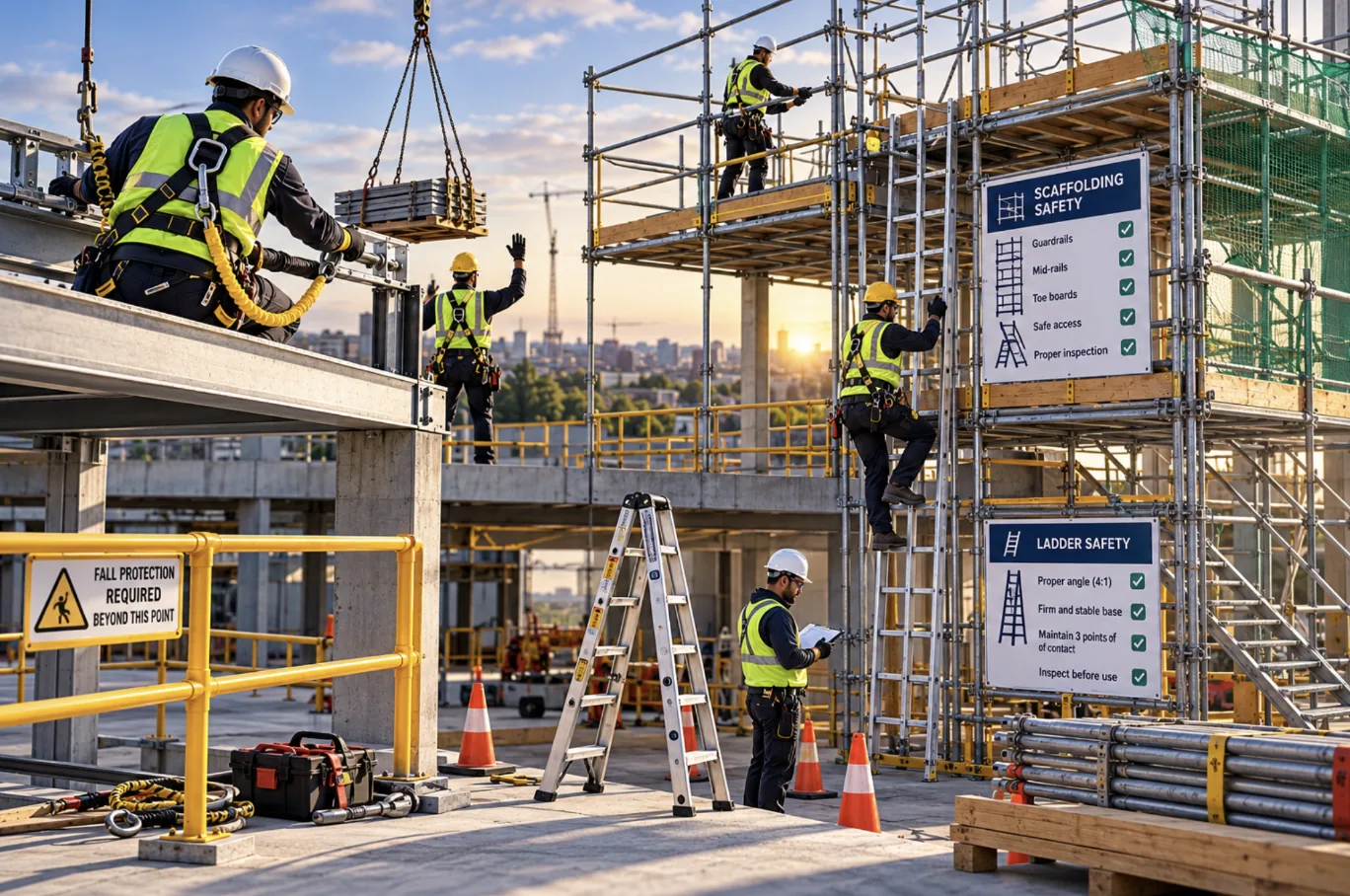
Spot the controls
Look closely at the picture. Tap each item to see what it shows, and the question a practitioner should still ask about it.
1 / 6
The worker at the beam edge
A full-body harness with an energy-absorbing lanyard, connected while working at an unprotected edge. Still ask: is the anchor rated, is it above or below the D-ring, and is there enough clearance below for the lanyard to arrest a fall?
The scaffold
Guardrails, mid-rails, toe boards, boarded platforms and netting on the face: collective protection for everyone on it. Still ask: is it tagged, and when did a competent person last inspect it?
The climb inside the scaffold
Access by a ladder built into the scaffold, climbing facing the ladder and holding on. Still ask: is the ladder secured, does it extend above the landing, and is there a protected gap or gate at the top?
The yellow guardrail and the sign
Edge protection and a sign marking where fall protection becomes mandatory. Still ask: is the guardrail rated and complete along the whole edge, or only where the picture shows it?
The load in the air
A crane is lifting a load with a signaller directing it. Still ask: is anyone working beneath or beside the load path, and is there an exclusion zone for falling objects?
The clipboard and the stepladder
A worker inspecting equipment, and a stepladder standing ready. Still ask: was the stepladder pre-use checked, and is a stepladder really the right tool for the next task?
Gravity gives you no time
Tap each height to see how fast a falling body is travelling when it lands, and how long the fall lasts. These are physics, not estimates: speed at impact is √(2gh), ignoring air resistance.
Even the slowest of these falls is over before a person can grab anything. That is why fall protection has to be in place before the slip, trip or structural failure, never as a reaction to it.
The enforcement picture
In US OSHA’s list of most frequently cited standards for fiscal year 2025, four of the top ten relate to work at height:
1No. 7: Fall protection training (1926.503)
Workers exposed to fall hazards had not been trained by a competent person to recognise the hazards and use the protection provided, or no written training certification existed.
2No. 6: Scaffolding (1926.451)
Missing guardrails, incomplete planking, unsafe access, and scaffolds not inspected by a competent person before each shift.
3No. 3: Ladders (1926.1053)
Ladders not extending 3 ft (0.9 m) above the landing, the top step of a stepladder being used, and damaged ladders left in service.
4No. 1: Fall protection, general requirements (1926.501)
Unprotected sides, edges, holes and roofs. It has topped the list for 15 fiscal years in a row.
Is this work at height?
A useful working definition, used in UK and much EU guidance, is: any place where, if no precautions were taken, a person could fall a distance liable to cause personal injury. Note what is missing: there is no minimum height. Decide for yourself, then tap to check.
1 / 6
Standing on a chair to reach a shelf
Yes. Any fall that could injure counts, and a chair is not designed to be a work platform.
Walking next to an open excavation 2 m deep
Yes. A fall can be to a level below the ground you stand on.
Driving a forklift on a warehouse floor
No, not in itself. It becomes work at height if someone stands on the forks or on a pallet lifted by them, which should never happen without an approved work platform.
Loading a lorry trailer bed 1.3 m high
Yes. Falls from vehicles and trailer beds cause many serious injuries.
Walking across a roof with fibre-cement sheets
Yes. The roof surface itself may be fragile, so the fall can happen through it rather than off the edge.
Office work on the 20th floor behind fixed glazing
No. There is no risk of falling a distance liable to cause injury.
Knowledge checkA colleague says work at 1.5 m is "not really height work, so no plan is needed". Is that right?
No. A fall from 1.5 m reaches about 20 km/h in about half a second and can kill, particularly if the head strikes first. Legal trigger heights (see Lesson 3) decide which specific rules apply, but the duty to assess and control the risk applies at any height.
The international framework: ILO and the European Union
There is no single worldwide work-at-height law. Instead, the requirements come in layers: international labour standards from the ILO, regional law such as the EU directives, national law, and finally the site’s own rules. Tap each layer.
Conventions and recommendations adopted by governments, employers and workers. A convention binds a country only once that country ratifies it, but ILO codes of practice are widely used as a benchmark everywhere.
EU directives set minimum requirements that every Member State must transpose into national law. They are a floor, not a ceiling.
The law that is actually enforced on site: for example national work-at-height regulations, technical rules or construction regulations. It can go further than the directive.
Technical standards (EN, ISO, ANSI) describe how equipment is designed, tested and used. They become mandatory when the law or a contract refers to them.
Client and contractor procedures, permits and life-saving rules. These are often stricter than the law, and you are bound by them on that site.
Tap a stage to see what it covers.
The ILO instruments
1 / 5
C155 and C187
The Occupational Safety and Health Convention, 1981 (C155) and the Promotional Framework for OSH Convention, 2006 (C187). Since the International Labour Conference of June 2022, a safe and healthy working environment is a fundamental principle and right at work, and these two are fundamental conventions.
C167, Article 14: scaffolds and ladders
Where work cannot safely be done from the ground or a permanent structure, a safe and suitable scaffold, or equally safe provision, must be provided and maintained. Ladders are provided only where there is no other safe means of access, and must be secured against inadvertent movement. Scaffolds must be inspected by a competent person at the times national law prescribes.
C167, Article 18: work at heights, including roof work
Preventive measures must be taken against the fall of workers and of tools, materials and objects. Where people work on or near fragile roof material, measures must prevent them stepping on or falling through it.
Recommendation R175
Accompanies C167 with more detailed guidance for national law and practice in construction.
Code of practice: Safety and health in construction
Revised and adopted by an ILO Meeting of Experts in February 2022, replacing the 1992 code. It gives detailed practical guidance on scaffolds, ladders, work on roofs, openings and fall protection, and is used as a reference in countries with little national guidance.
The European Union directives
Requirement
Source
0 of 4 matched
Practitioner note
Always check the national law that transposes these instruments where you work. For example, Germany applies them through the Ordinance on Industrial Safety and Health and the technical rule TRBS 2121, while the UK (no longer an EU member) still applies its Work at Height Regulations 2005, which were derived from the same directive.
United States: OSHA’s prescriptive requirements
Federal OSHA takes a more prescriptive approach than the EU: it sets specific trigger heights and numerical performance values. Which rule applies depends on whether the work is construction (29 CFR 1926) or general industry (29 CFR 1910).
Trigger heights
Tap each figure to see which rule it comes from.
These are the points where a specific federal rule switches on. They are not “safe heights” below which nothing is required: the employer’s general duty and other standards still apply. OSHA-approved State Plans, such as California’s, can set different or stricter requirements.
Where the rules live
Construction, Subpart M: Fall protection (1926.500 to 1926.503)
Where fall protection is required (1926.501), the criteria systems must meet (1926.502) and training (1926.503). Workers must be trained by a competent person, and the employer must keep a written certification of that training.
Construction, Subpart L: Scaffolds (1926.450 to 1926.454)
Capacity, platform construction, access, inspection, erection and fall protection on scaffolds, plus a training requirement for users and erectors (1926.454).
Construction, Subpart X: Stairways and ladders (1926.1050 to 1926.1060)
When ladders are required, ladder construction and use (1926.1053), and training (1926.1060).
General industry, Subpart D: Walking-working surfaces (1910.21 to 1910.30) and 1910.140
Revised in 2016. Covers ladders, stairs, scaffolds and rope descent systems, fall protection duties (1910.28), and criteria for personal fall protection systems (1910.140).
For fixed ladders over 24 ft (7.3 m): ladders installed on or after 19 November 2018 must have a personal fall arrest or ladder safety system, and by 18 November 2036 all such ladders must, so cages and wells are being phased out as fall protection.
Key numbers from 1926.502
1 / 6
Guardrail top rail
42 in (1.1 m) ± 3 in above the working level, withstanding at least 200 lb (890 N) applied near the top edge. A midrail sits midway, and toeboards are at least 3½ in (9 cm) high.
Anchorage
At least 5,000 lb (22.2 kN) per person attached, or designed and used under the supervision of a qualified person as part of a complete system with a safety factor of at least two.
Arresting force
A personal fall arrest system must limit the maximum arresting force to 1,800 lb (8 kN) with a full-body harness. Body belts have not been acceptable for fall arrest since 1 January 1998.
Free fall and deceleration
Free fall of no more than 6 ft (1.8 m), no contact with any lower level, and a deceleration distance of no more than 3.5 ft (1.07 m).
Safety nets
As close as practicable under the work surface, and never more than 30 ft (9.1 m) below it.
Hole covers
Able to support at least twice the weight of the people, equipment and materials on them, secured against displacement, and colour-coded or marked “HOLE” or “COVER”.
Two philosophies, one goal
US OSHA
Prescriptive. Specific trigger heights and numbers make compliance easy to measure and enforce. In construction, guardrails, safety nets and personal fall arrest are listed as acceptable options, without a formal hierarchy between them.
EU
Goal-setting and risk-based. There is no single EU trigger height. Employers must assess the risk and follow a hierarchy that puts collective protection before personal protection. National law fills in the numbers.
ILO
Sets the principles that national systems should implement: safe means of access and work, prevention of falls of people and objects, and competent inspection. Again, the numbers are left to national law.
Good practice everywhere
Avoid work at height where you can, then prefer collective protection over personal protection, whatever the minimum legal requirement. Consensus standards such as ANSI/ASSP Z359 and the EU directive point the same way.
Situation (US federal OSHA)
Rule that applies
0 of 4 matched
The hierarchy of control for work at height
Every credible framework, from the EU directive to the ILO code and modern consensus standards, asks the same sequence of questions. Tap each stage, from most effective to least.
Can the work be done without anyone going to height? Assemble on the ground and lift into place, use long-reach tools, lowering luminaires, drones or cameras for inspections, or design the hazard out (for example parapets or permanent rails).
Protect everyone, without anyone having to do anything: guardrails and edge protection, scaffolds with full guardrails, mobile towers, podium steps and MEWPs.
Work restraint: a harness and lanyard set so short that the person physically cannot reach the edge. It prevents the fall but depends on the person using it correctly.
The fall can still happen, but its distance and consequences are reduced for everyone: safety nets, soft-landing systems and airbags.
Personal fall arrest: harness, energy absorber or self-retracting device and anchor. It stops the fall after it starts, requires clearance and requires a rescue plan.
Ladders, procedures, training and supervision support every level. A ladder used as a workstation is only acceptable for low-risk, short-duration work where nothing safer is justified.
Tap a stage to see what it covers.
Why collective beats personal
Collective measures protect everyone in the area, all the time, without relying on each person choosing correctly, wearing equipment properly, finding a suitable anchor or being rescued in time. A harness can only protect if all of those things go right.
Choosing the right equipment
1 / 6
Mobile elevating work platform (MEWP)
Scissor and boom lifts give a guarded platform at height and are quick to reposition. Needs a trained operator, firm level ground, a wind check against the manufacturer’s limit and a rescue plan. On booms, a short restraint lanyard is normally worn to stop the person being thrown out.
Podium steps
Low-level platforms with guardrails on all sides. A good replacement for stepladders for repetitive interior work.
Mobile access tower
Prefabricated aluminium towers for medium-height, medium-duration work on firm level surfaces. Must be assembled by trained people using the manufacturer’s method.
Fixed or independent scaffold
For longer-duration work, heavy loads or large areas. Designed, erected and inspected by competent people.
Rope access
Where other equipment is not practicable, for example on facades or in structures. Needs two independently anchored ropes, specialist training and an immediate rescue capability.
Ladder or stepladder
Only for low-risk, short-duration work where a safer option is not justified: think minutes, not hours, with light tools and three points of contact.
Your callTwo electricians must replace 40 high-bay light fittings 7 m above a warehouse floor. The floor is flat and clear. The job will take two days. What is the most suitable access method?
Two days of overhead work with tools and fittings in hand is neither low-risk nor short-duration. It fails the EU test for ladders as workstations and the practical test of a secure handhold.
Correct. Firm, level floor, repetitive work and a guarded platform at the right height: a MEWP gives collective protection and is quick to reposition between fittings.
Rope access is for situations where other equipment is not practicable. Here it adds complexity and rescue demands for no benefit.
Never. A pallet on forks is not a work platform, has no guardrails and can tip or slide off.
Your callA building manager wants the gutters on a two-storey house inspected for blockages. What should be considered first?
A ladder may be acceptable, but only after asking whether anyone needs to go up at all.
Correct. The first question is always "can we avoid work at height?". Here the inspection itself can be done from the ground; clearing the gutter may still need access equipment.
Possibly needed for major repairs, but disproportionate before anyone knows whether the gutters are even blocked.
Planning, permits and competence
Every credible framework requires work at height to be properly planned, appropriately supervised and carried out by competent people. Step through a practical planning sequence.
Define the task. What exactly will be done, where, for how long, how often, with which tools and materials?
Challenge the need. Can any of it be done from the ground or designed out?
Survey the location. Edges, openings, fragile surfaces, ground conditions, overhead power lines, traffic, other trades, and access and egress routes.
Check the conditions. Wind (against the equipment’s stated limit), rain, ice, heat, lighting and the time available before conditions change.
Select the equipment by following the hierarchy, and confirm it is inspected, suitable and correctly rated.
Confirm competence and fitness. Trained, authorised people, fit for the work that day, with adequate supervision.
Control falling objects. Toeboards, tool tethering, netting and an exclusion zone below.
Plan the rescue before work starts: who, with what equipment, and how quickly.
Brief, permit and supervise. Issue the permit if your system requires one, brief the team and monitor the work.
Stop and re-assess on any change to the weather, the task, the people or the equipment.
1 / 10
Who is “competent”?
OSHA: competent person (1926.32(f))
Someone capable of identifying existing and predictable hazards that are unsanitary, hazardous or dangerous to employees, and who has authorisation to take prompt corrective measures to eliminate them. Knowledge without authority to act is not enough.
OSHA: qualified person (1926.32(m))
Someone who, by a recognised degree, certificate or professional standing, or by extensive knowledge, training and experience, has demonstrated the ability to solve problems relating to the subject. For example, the person who designs anchorages that do not meet the 5,000 lb rule.
EU and ILO: competent person
Defined by national law and practice. Usually someone with sufficient training, experience and knowledge, and the personal qualities, to carry out a specific task, such as inspecting scaffolds, properly.
Training duties
US: 1926.503 (fall protection), 1926.454 (scaffolds) and 1926.1060 (ladders). EU: Articles 12 of 89/391/EEC and 9 of 2009/104/EC, plus specific training for scaffold assemblers (Annex II 4.3.6) and rope access workers (4.4).
A work-at-height permit check
Many sites control higher-risk work at height with a permit to work. Tick off what a good permit confirms before work starts.
Avoidance was considered and the selected access method follows the hierarchy.
Access equipment is inspected and tagged, and personal fall protection has passed its pre-use check.
Edges, openings and fragile surfaces are identified and protected.
An exclusion zone below is set up, and tools are tethered.
Weather limits are stated and checked.
The rescue plan, rescue equipment and rescuers are confirmed.
The people are named, trained, authorised and briefed.
Knowledge checkWhy does OSHA’s definition of a competent person include the authority to take corrective action?
Because spotting a hazard is not enough. A competent person who finds a missing guardrail or a damaged scaffold must be able to stop the work and get it fixed immediately, without waiting for permission.
Ladders and stepladders
Ladders are the most common access equipment in the world, and one of the most common sources of fall injuries. They are not banned anywhere, but every framework treats them as a last choice for working at height.
When a ladder may be used as a workstation
EU law: only where the risk is low and the use is of short duration, or existing site features cannot be altered (Directive 2009/104/EC, Annex II 4.1.2). UK HSE guidance gives a practical rule of thumb of no more than about 30 minutes in one position, light work only, and three points of contact or a secure handhold.
Before you climb: the pre-use check
Feet: present, not worn, and clean, with no mud or grease.
Stiles (side rails): not bent, split, cracked or corroded.
Rungs or steps: secure, not bent, not missing, free of contamination.
Stepladder locking bars and hinges: not bent, and engage fully.
Platform or top cap, and any stabiliser: undamaged and secure.
Labels: rating and standard (e.g. EN 131) visible; a defective ladder is tagged “Do Not Use” and removed.
Setting up a leaning ladder
Using it safely
1 / 6
Three points of contact
Two hands and a foot, or two feet and a hand, while climbing. US rules require the climber to face the ladder and use at least one hand to grasp it; EU law requires a secure handhold and support at all times.
Don’t overreach
Keep your belt buckle (navel) between the stiles and both feet on the same rung. Move the ladder instead of stretching.
Carrying loads
Do not carry anything that stops you holding on securely. Use a tool belt, or haul materials up separately.
Stepladders
Use them open and locked, front-on to the work. Never stand on the top cap or top step (US 1926.1053(b)(13)). In UK practice, do not stand on the top two steps unless there is a suitable handhold.
Electricity
Where a ladder could contact exposed energised conductors, use ladders with non-conductive side rails and keep clear of overhead lines.
Standards
In Europe, EN 131-1:2015+A1:2019 has two classes, professional and non-professional, both rated to a 150 kg maximum total load, and requires a wider base (stabiliser) on leaning ladders over 3 m. In the US, ladders are typically certified to ANSI A14 standards.
Your callA technician needs to adjust a sensor about 3.5 m up a wall. The task takes 10 minutes, needs one hand, and the floor is level and dry. A 4 m stepladder is available. What is the correct approach?
Standing on the top step or top cap removes any handhold and is specifically prohibited in the US.
Correct. Short duration, light work and a secure handhold: a ladder may be justified, provided it is the right size and set up correctly.
An improvised platform with no stability and no handhold is never acceptable.
Knowledge checkA leaning ladder is 4 m high where it rests on the wall. How far out should its foot be?
About 1 m. The 1-in-4 rule puts the foot one unit out for every four units up, giving an angle of about 75°.
Scaffolds: types and components
A scaffold is a temporary structure, but it must be designed, erected and inspected as seriously as a permanent one. Most scaffold collapses trace back to a weak foundation, missing ties or bracing, or overloading.
Common scaffold types
1 / 6
Tube and fitting
Steel tubes joined by couplers. Very flexible for complex shapes, but entirely dependent on the skill of the erectors and correct coupler torque.
System (modular) scaffold
Prefabricated standards, ledgers and braces with fixed connection nodes. Faster and more repeatable to erect. Prefabricated facade systems are covered in Europe by EN 12810.
Frame scaffold
Common in the US: prefabricated welded end frames joined with cross braces. Simple, but easily compromised if braces are removed.
Mobile access tower
Lightweight, usually aluminium, on lockable castors. European towers are covered by EN 1004-1. They are assembled using the manufacturer’s instructions and method (see the next lesson).
Suspended scaffold (swing stage, cradle)
Platforms hung on wire ropes from roof rigs or davits. The suspension system, counterweights and an independent fall arrest line for each worker are critical.
Trestle and cantilever scaffolds
Trestles are for low-level work. Cantilever and birdcage scaffolds need engineered design.
Know the parts
1 / 8
Base plate and sole board
Spread the load of each standard onto the ground. Sole boards are needed on soft or uneven ground. A standard sitting directly on soil or on loose bricks is a serious defect.
Standards
The vertical tubes that carry the load down to the base.
Ledgers and transoms
Ledgers run horizontally along the scaffold; transoms span across it and support the boards.
Bracing
Diagonal tubes that stop the scaffold racking (leaning sideways) or swaying. Removing bracing “for access” can lead to collapse.
Ties
Connect the scaffold to the building to stop it falling outward or inward. Ties must never be removed without the scaffold supervisor’s authority and an alternative.
Platform (deck)
Fully boarded, with no gaps, and secured against displacement. US: at least 18 in (46 cm) wide in most cases.
Guardrail, midrail and toeboard
The collective edge protection. Toeboards and brick guards also stop tools and materials falling.
Access
Built-in stair towers or ladders. The US requires safe access whenever a platform is more than 2 ft (0.6 m) above or below the access point. Climbing the frame is not access.
Component
Its job
0 of 5 matched
Design and capacity
Capacity
US 1926.451(a)(1): each scaffold and component must support its own weight and at least four times the maximum intended load. Never exceed the loading class or duty rating.
Calculation
EU Annex II 4.3.1: strength and stability calculations are required unless the scaffold is assembled in a generally recognised standard configuration.
Assembly plan
EU Annex II 4.3.2: a competent person must draw up an assembly, use and dismantling plan, which may be a standard plan supplemented for the specific scaffold.
Stability
US 1926.451(c)(1): supported scaffolds taller than four times their minimum base width must be restrained from tipping by guying, tying or bracing.
Knowledge checkA scaffold is 2.4 m wide at its base. Above what height does OSHA require it to be tied, guyed or braced against tipping?
Above 9.6 m. The 4:1 rule means anything taller than four times the minimum base dimension (4 × 2.4 m) must be restrained.
Erection, inspection and mobile towers
Erection, alteration and dismantling
Scaffolds may only be erected, altered, moved or dismantled by trained people under competent supervision: in the US by a competent person qualified in scaffold erection (1926.451(f)(7)), and in the EU under the supervision of a competent person, by workers trained in the specific risks (Annex II 4.3.6). During these phases the erectors themselves are at the greatest risk, so methods that give them guardrail protection before they step onto a new lift (advance guardrail systems) are strongly preferred.
When must a scaffold be inspected?
After erection, before first use. EU: Directive 2009/104/EC, Article 5 (equipment whose safety depends on its installation). ILO C167: inspection by a competent person as national law prescribes.
Before each work shift (US). 1926.451(f)(3): a competent person inspects for visible defects before each shift.
Periodically (EU and national law). At intervals set nationally. For example, the UK requires working platforms 2 m or higher to be inspected at least every 7 days.
After any event that could affect it: alteration, adverse weather, impact, partial dismantling, or a long period out of use.
Record it. Keep a written inspection record and tag the scaffold with its current status at every access point.
1 / 5
Scaffold tags: a status at a glance
Most sites use a tag at each access point. Tagging systems are a site practice rather than a legal requirement, but they make the inspection status visible to every user.
Inspected and complete. The tag shows the date, the inspector, the load class and the next inspection due.
Used on many sites for scaffolds with a known restriction, for example a section with guardrails removed for loading, where users must wear harnesses or follow specific instructions.
Incomplete, under erection, failed inspection, or not yet inspected. No tag means do not use.
Tap a tag to see what it means.
Defects you must not walk past
1 / 6
Missing or removed guardrails
Often removed by another trade to land materials and never replaced. Stop, report it, and keep people off until it is restored and re-inspected.
Ties removed
Facade work often tempts trades to remove ties. Without them the scaffold can collapse outward. Only the scaffold contractor may relocate ties.
Undermined or soft base
Excavations, washouts or vehicle impact near base plates. A settling standard can bring a scaffold down.
Unsecured or damaged boards
Boards that rock, overhang too far, are split or leave gaps.
Overloading
Stacked bricks, blocks or equipment beyond the scaffold’s load class.
Unauthorised alterations
Any change made by someone who is not a competent scaffold erector invalidates the last inspection.
Your callYou arrive at a green-tagged scaffold and find a section of guardrail has been removed and left on the platform. Nobody is around. What do you do?
Well meant, but only a competent scaffold erector should alter or reinstate scaffold components, and the scaffold needs re-inspection afterwards.
The scaffold is no longer in the condition its green tag certifies. Other people may use it without noticing the gap.
Correct. The tag no longer reflects reality. Stop, protect others and get the competent person to deal with it.
Mobile access towers
Assemble by the method
Follow the manufacturer’s instructions, using a method that protects the assembler: advance guardrail or “through-the-trap” methods, so that guardrails are in place before anyone stands on a new platform.
Stability
Use outriggers or stabilisers as specified, and never exceed the manufacturer’s maximum platform height. Check the wind and never use towers as anchors for hoisting loads unless they are designed for it.
Castors and ground
Firm, level ground. Lock the castors whenever the tower is in use (EU Annex II 4.3.3 requires devices preventing accidental movement).
Moving the tower
Never move a tower with people or materials on it unless the manufacturer and the applicable rules specifically allow it. Watch for overhead obstructions, power lines, holes and slopes.
Edges, openings, fragile surfaces and falling objects
Many fatal falls happen not from access equipment but through openings and fragile surfaces, often during maintenance work by people who did not expect a fall hazard to be there.
Fragile surfaces
Rooflights and skylights
Often painted over or dirty, and indistinguishable from the roof. US OSHA treats skylights as holes that need covers or guardrails.
Fibre-cement sheets
Common on older industrial roofs. They become more brittle with age and may contain asbestos.
Liner panels and old metal sheets
Corrosion can leave a sheet looking intact while being unable to carry a person’s weight.
Glass, glazing and cladding
Canopies and glazed roofs are not designed for foot traffic.
Treat every roof as fragile until a competent person confirms otherwise. Controls include working from below using a MEWP, staging or crawling boards with edge protection, covers over rooflights, and safety nets beneath. Crawling boards alone are not enough if people can still step off them onto fragile sheets.
Openings and edges
Floor holes and shafts
Guard with guardrails or cover with a secured cover able to take at least twice the expected load (US 1926.502(i)), marked “HOLE” or “COVER”.
Leading edges
On decking, roofing and formwork, the edge moves as the work progresses. These need specific methods, for example installing edge protection ahead of the work or working from below.
Wall openings
Openings at floor level, such as lift shafts, loading doors and unglazed windows, need guardrails or barriers.
Temporarily removed protection
Guardrails removed to land materials are a classic fatal scenario. Use a loading bay gate, a permit and restraint, and reinstate the protection immediately.
Falling objects: the energy is real
Tap each dropped object to see the energy it carries at impact. An EN 397 industrial safety helmet is tested against an impact of only about 50 J.
Controls for falling objects
Hazard
Control
0 of 4 matched
Your callA roofer needs to replace a broken rooflight on a fibre-cement roof 8 m up. What should come first in the plan?
Relying on walking along the fixing lines is exactly how many roofers have fallen through fragile sheets.
Correct. Fragile roofs need protection against falls through the surface, not just off the edge (ILO C167 Article 18).
The rooflight frame is not a rated anchor, and it may be the very part that fails.
Personal fall protection systems
Personal fall protection is low in the hierarchy, but it is often essential. Used properly, it saves lives; used carelessly, it gives false confidence. Every system depends on four elements.
A rated anchor point or device. US: at least 5,000 lb (22.2 kN) per person, or designed by a qualified person with a safety factor of two. EU: anchor devices tested to EN 795. Never use pipework, handrails, conduit or the rooflight frame unless a competent person has confirmed they are suitable.
A full-body harness (EN 361 in Europe), correctly sized and adjusted. A body belt or waist belt is never acceptable for fall arrest.
Energy-absorbing lanyards (EN 355), self-retracting devices (EN 360), guided-type arresters on rigid or flexible lines (EN 353), and karabiners and hooks (EN 362), all compatible with each other and with the anchor.
A plan and equipment to recover a suspended worker quickly. Without this, a fall arrest system can turn an arrested fall into a fatality.
Tap a stage to see what it covers.
Restraint, positioning or arrest?
System
What it does
0 of 4 matched
Clearance: will the system stop you in time?
A fall arrest system needs space below the anchor to work. Step through an illustrative calculation for a 2 m energy-absorbing lanyard attached at foot level. Always use the manufacturer’s clearance data for real equipment.
Lanyard length: 2.0 m. The free fall before the lanyard goes tight.
Energy absorber deployment: up to 1.75 m. The maximum extension allowed for an EN 355 absorber as it tears open to slow you down.
Harness stretch and D-ring movement: about 0.5 m. The harness shifts upward as it takes your weight.
Distance from the D-ring to your feet: about 1.5 m. Your feet hang below the attachment point.
Safety margin: 1.0 m. Space so that your feet do not touch the ground or an obstruction.
Total: about 6.75 m below the anchor. On a platform 5 m high, this system would let you hit the ground. Use restraint, a self-retracting device with a short arrest distance, or an overhead anchor instead.
1 / 6
1 / 6
Free fall limits
US 1926.502(d)(16): free fall of no more than 6 ft (1.8 m), and no contact with any lower level. Anchor overhead wherever possible to minimise free fall.
Swing fall
If the anchor is offset to the side, the arrested person swings like a pendulum and can strike structures, or the lanyard can be cut on an edge. Anchor as directly overhead as possible, and use edge-rated equipment where lines run over edges.
Pre-use check
Before every use the user checks webbing, stitching, buckles, D-rings, labels, connectors and the energy absorber pack and fall indicators (US 1926.502(d)(21)).
Periodic examination
A detailed examination by a competent person at least every 12 months (EN 365), often more frequently in harsh conditions. Record the results.
After a fall
Remove any equipment that arrested a fall from service immediately. In the US, it may not be reused until a competent person inspects it and determines that it is undamaged (1926.502(d)(19)); many manufacturers require it to be discarded.
Product certification
EU: fall-arrest PPE is Category III under Regulation (EU) 2016/425, with CE marking and a notified-body number. US: personal fall protection equipment is commonly certified to the ANSI/ASSP Z359 Fall Protection Code.
Knowledge checkA worker on a MEWP basket clips a 2 m energy-absorbing lanyard to the basket anchor. Is this fall arrest or restraint, and is that correct?
In a boom-type MEWP, the lanyard should be short enough to act as restraint, keeping the person inside the basket. A 2 m fall-arrest lanyard could allow the person to be thrown out and fall, with the machine itself as the anchor. Follow the manufacturer’s instructions for the anchor point and lanyard type.
Rescue and suspension intolerance
A fall arrest system has done only half its job when it stops a fall. The person is now hanging in a harness, possibly injured, and the clock is running.
Suspension intolerance
Hanging motionless in a harness can restrict blood return from the legs and lead to fainting and, potentially, death. Symptoms can develop within minutes, especially if the person is injured or unconscious. US OSHA has issued a Safety and Health Information Bulletin on the subject, and 1926.502(d)(20) requires employers to provide for the “prompt rescue” of employees after a fall.
Rescue options, from fastest to slowest
The person climbs back to the structure or uses a self-rescue device. Only possible if they are conscious, uninjured and trained. Suspension relief straps let a conscious person stand in loops to take pressure off the legs while waiting.
Trained colleagues use pre-planned equipment: a MEWP brought under the casualty, or a pre-rigged rescue and lowering kit that can lower the person to the ground without anyone else going to height.
A backup, never the plan. Their response time, access to the site and specialist rope-rescue capability are usually unknown, and few can reach a suspended worker within minutes.
Tap a stage to see what it covers.
What a rescue plan must answer
1. Who
Who will carry out the rescue? Named, trained people, present whenever work at height is under way.
2. With what?
With what? Rescue kit or a MEWP, available at the work location, inspected and compatible with the fall arrest system.
3. How fast?
How fast? A realistic time to reach the casualty, which should be measured in minutes and confirmed by drills.
4. How will the alarm be raised?
How will the alarm be raised? Communication that works at height and in noisy areas, and a lone-working arrangement where needed.
5. Aftercare.
Aftercare. First aid and medical assessment for every person who has been suspended, even if they say they feel fine.
1 / 5
Older guidance advised keeping a rescued person in a sitting position. UK HSE research (RR708, 2009) found no evidence to support this, and current guidance is to give normal first aid. Follow your first-aid training and medical advice.
Your callA worker’s fall is arrested at 9 m on a steel structure. They are conscious but injured and cannot climb back. The nearest fire station with a rope-rescue team is 25 minutes away. What should happen?
Waiting 25 minutes or more, before the team even sets up, leaves an injured person hanging far too long. Emergency services are the backup, not the plan.
Correct. The rescue plan has to work in minutes. Calling the emergency services happens at the same time, not instead.
Leg movement may help a conscious person for a short time, but it is no substitute for getting them down quickly.
Knowledge checkWhy is "call the emergency services" not an acceptable rescue plan on its own?
Because they rarely arrive and reach a suspended worker within minutes, and many lack the specialist equipment for the structure. The employer remains responsible for providing prompt rescue.
Case study: the warehouse roof fan
Apply everything so far to one realistic job. Make each decision, then read the debrief.
A contractor is asked to replace a failed extract fan on a warehouse roof. The roof is 6 m high, with fibre-cement sheets and rooflights, and has no permanent edge protection. The contractor’s plan is to climb a leaning ladder at the eaves, walk across the roof along the fixing lines, and wear a harness with a 2 m lanyard clipped to the fan housing. Two people, half a day’s work.
Decision 1Decision 1: How should the team gain access to the roof and protect against falls from the edge?
Access by ladder may be acceptable, but it does not address the 6 m unprotected roof edge they will work near for half a day.
Correct. Collective prevention at the edge protects both workers all the time, and a tower or MEWP gives safer access than a leaning ladder at the eaves.
A safety watcher is an administrative control, the weakest kind. It cannot stop a fall.
Decision 2Decision 2: How should the fragile roof be handled?
This relies on perfect foot placement on a surface that cannot be trusted. Falls through fragile roofs are a classic fatal scenario.
Correct. ILO C167 Article 18 specifically requires measures against stepping on or falling through fragile material.
Marking warns but does not prevent anyone falling through a rooflight or a sheet.
Decision 3Decision 3: Is the planned harness system suitable?
A harness is only effective with a rated anchor, adequate clearance and a rescue plan.
Correct. Restraint, which keeps the person from reaching the edge or the fragile areas, prevents the fall instead of relying on clearance and rescue.
A longer lanyard increases free fall and the clearance needed, and makes things worse.
Debrief: how the law maps onto this job
ILO
C167 Article 18: preventive measures against falls of workers, and against falling through fragile material. Article 14: safe and suitable scaffolds or equally safe provision where the work cannot be done safely from a permanent structure.
European Union
89/391/EEC: assess the risk and give priority to collective protection. 2009/104/EC Annex II: select the most suitable equipment, with collective protection before personal protection, and use ladders as workstations only for low-risk, short-duration work. National law sets the details.
United States (construction)
1926.501(b)(4) requires holes, including skylights, to be protected by covers, guardrails or personal fall arrest, and the 6 ft edge requires guardrails, nets or personal fall arrest. 1926.502(d) sets anchor, free fall and rescue requirements. Workers must be trained under 1926.503.
What good looks like
A written plan, edge protection and a protected walkway, protected rooflights, tool tethering with an exclusion zone below, a rescue plan with equipment on site, and a briefing for both workers before they start.
Final assessment
The assessment has ten scenario-based questions drawn from a larger bank and reshuffled for every attempt. A verified learner must complete all lessons and score at least 80%. This certificate confirms completion of a Level 2 practitioner course and the recorded assessment score. It does not authorise anyone to erect, alter or inspect scaffolds, operate MEWPs, perform rope access or design anchorages; those require practical training and authorisation by the employer under the applicable national law.
Question 1 of 10