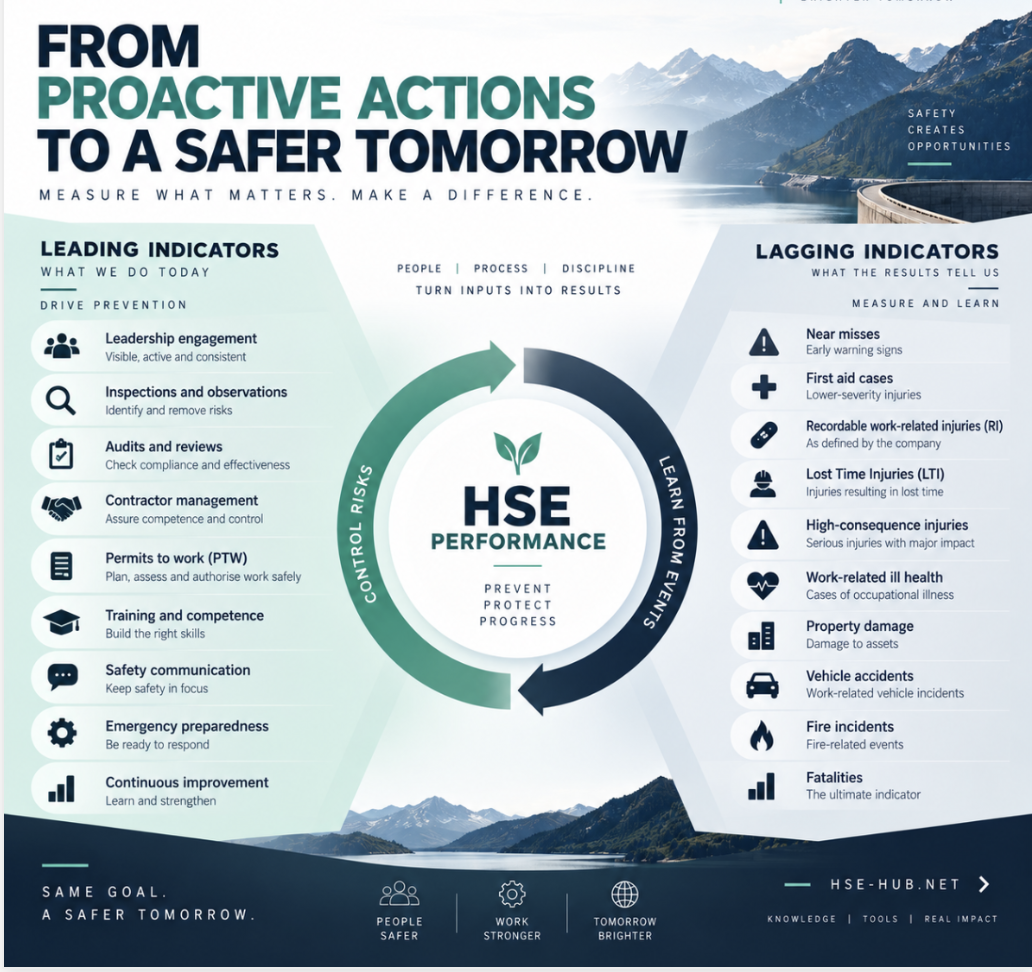
Two kinds of indicator, not one
An organization can hold its lowest injury rate in years while still missing the exposure that eventually hurts someone. That is not a contradiction. A lagging indicator counts harm, or near-harm, that has already happened. A leading indicator measures whether the activity meant to prevent that harm is actually being carried out. They answer two different questions, and a programme that only tracks one of them is only getting half the picture.
Everything a leading indicator measures sits in this base: audits happening, permits reviewed, training delivered, toolbox talks held. It's the widest layer, the one furthest from harm, and the only part of the triangle a leader can still act on before anything goes wrong.
Near misses and unsafe conditions sit here: the corners quietly cut, the wrench that almost hit someone. They're cheap, early warnings, if anyone reports them.
Injuries, lost-time events and fatalities sit at the top. Every serious outcome here sits above a much larger set of ordinary events underneath it. The exact ratios in any version of this triangle vary enormously by industry and by how honestly near misses get reported, so treat the shape as illustrative rather than a target to expect on your own site.
Tap a layer to see what it measures.
A warehouse records two numbers every month: how many forklift pre-shift inspections actually got completed, and how many forklift collisions happened. The inspection count is a leading indicator: it tells you whether the check is being done before anything goes wrong. The collision count is a lagging indicator: it tells you the check failed, or wasn't enough, only after the fact. If collisions drop to zero for six months, that could mean the inspections are working, or it could mean nobody has hit anything yet by chance. The inspection count is the one number that tells you which.
| Question | Leading indicators | Lagging indicators |
|---|---|---|
| Definition | Measure the activity meant to prevent harm | Measure harm, or near-harm, that has already occurred |
| Time orientation | Forward-looking, before an event | Backward-looking, after an event |
| Tells you | Whether your controls are actually being carried out | Whether your controls actually worked |
| Typical owner | Line supervisors and the HSE team, day to day | Investigation team and senior management |
| Reporting rhythm | Weekly or monthly, continuously | As each event occurs, then reviewed in trend |
| Example | HSE audits completed on schedule | Recordable work-related injuries |