Know your designated assembly area and at least one secondary exit path in case your primary route is blocked.
Level 1 · Free · Self-paced
Fire Safety and Emergency Response
Learn the fire triangle, how to operate a portable extinguisher safely, and how alarms and evacuation protocols work.
0% complete
Training boundary
This is awareness training. It does not qualify you as a certified fire warden, fire marshal or Fire Protection Assistant (Brandschutzhelfer), does not authorize you to conduct a workplace fire risk assessment, and does not replace hands-on extinguisher discharge practice, a live fire drill, or your site's approved emergency action plan. Follow your employer's fire safety procedures and the applicable law for your country.
The fire triangle
Fire needs three things to exist at the same time: heat, fuel and oxygen. Together they are known as the fire triangle. Remove any one of the three and a fire cannot start, or an existing fire is suppressed.
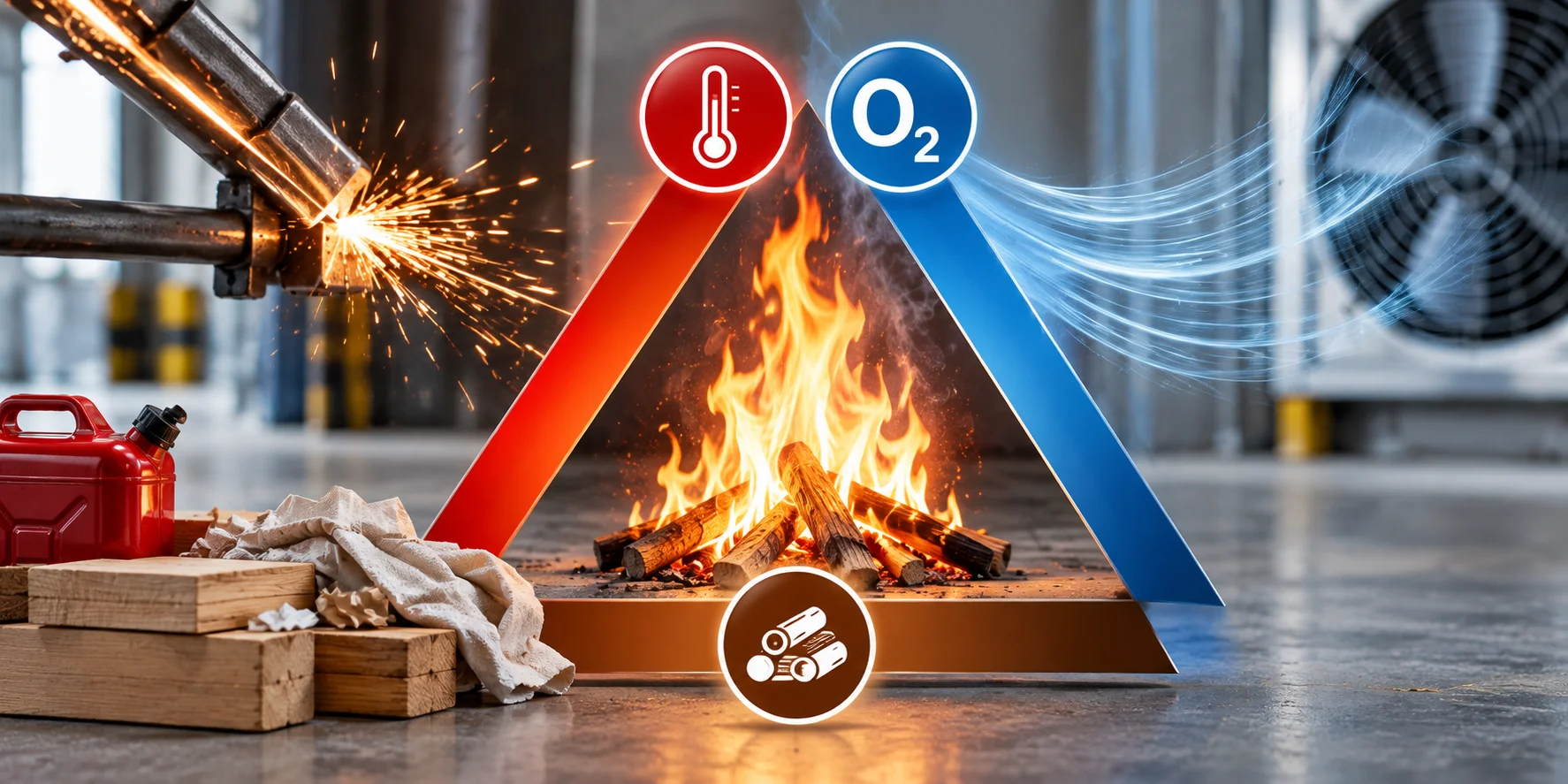
The three elements
An ignition source hot enough to raise the fuel to its ignition temperature, such as a spark, a flame, a hot surface or an electrical fault.
Any material that can burn, including wood, paper, fabric, flammable liquids, gases and combustible dust.
Normally present in the surrounding air at a concentration high enough to sustain combustion.
Tap a stage to see what it covers.
Fire prevention and firefighting both work by removing one side of the triangle: cooling the fuel below its ignition temperature, removing or isolating the fuel, or cutting off the oxygen supply.
Action
Side of the triangle removed
0 of 3 matched
This course trains you to recognize fire hazards, report a fire promptly, use extinguishing equipment safely within the limits of your training, and follow your site's evacuation plan. It does not replace live fire drills or hands-on extinguisher practice supervised by a competent instructor.
Fire extinguisher operation
Portable fire extinguishers are for a fire that is still small and in its early stages, and only when you have a clear escape route behind you. If a fire is spreading, producing heavy smoke, or you are unsure, evacuate and let trained responders handle it.
Fire classes and matching extinguisher types
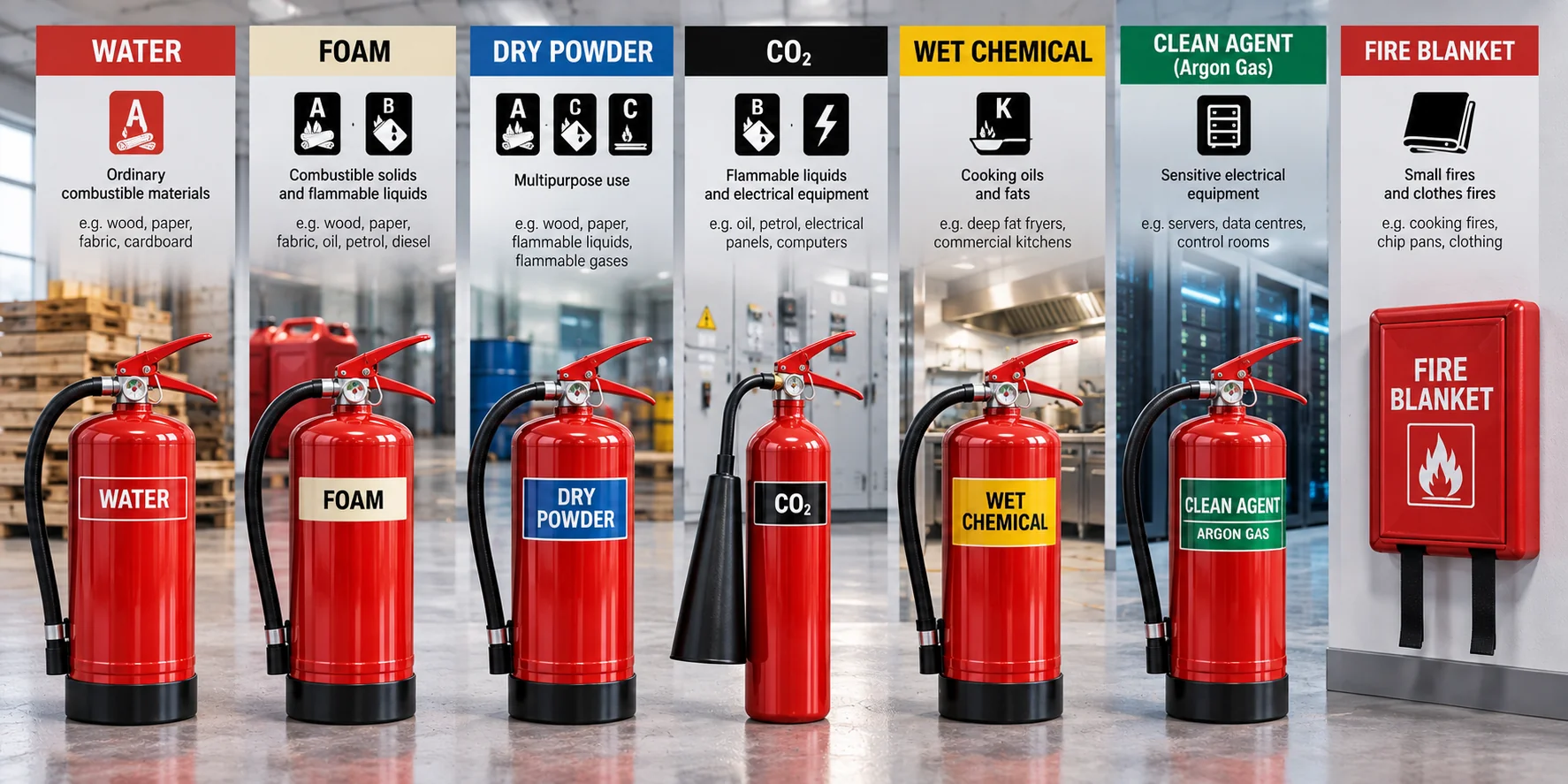
Fires are classified by what is burning, and each class needs a specific extinguishing agent. Using the wrong one can spread the fire, cause an electric shock, or trigger a violent reaction:
| Fire class | Typical fuel | Suitable agent | Never use |
|---|---|---|---|
| Class A | Wood, paper, cloth and other ordinary combustibles | Water, foam, or multi-purpose dry chemical (ABC) | — |
| Class B | Flammable liquids and gases: fuel, solvents, paints | Foam, CO2, dry chemical, or a clean agent | Water, which can spread a burning liquid |
| Electrical (Class C in the US system) | Energized electrical equipment, switchgear, wiring | CO2 or a clean agent, since neither conducts electricity or leaves residue | Water or foam, which risk electric shock |
| Class D | Combustible metals: magnesium, titanium, sodium, lithium | A specialist Class D dry powder agent only | Water, foam, CO2 or standard dry chemical, which can react violently with burning metal |
| Class K (US) / Class F (international) | Cooking oils and fats, commercial kitchen fryers | A wet chemical extinguisher | Water, which can cause a violent steam and oil eruption |
What's burning
Agent to reach for
0 of 5 matched
Server rooms and archives: clean-agent and inert-gas systems
Some environments need an agent that leaves no residue and does not conduct electricity, such as server rooms, data centers, telecom exchanges and archives. These are usually protected by fixed clean-agent or inert-gas suppression systems rather than handheld extinguishers. Inert gases such as argon (for example, in Argonite or IG-541 systems) suppress fire by reducing the room's oxygen concentration below the level needed to sustain combustion, while remaining breathable for a limited time so people can evacuate. Clean chemical agents (such as FM-200 or Novec 1230) interrupt the chemical reaction of combustion instead. Both leave no residue and will not damage sensitive electronic equipment, unlike water, foam or standard dry chemical.
Fire blankets
A fire blanket is a separate option for a small contained fire, such as a pan fire or clothing that has caught fire: it works by smothering the fire and cutting off its oxygen supply, without needing a discharge agent at all.
The P.A.S.S. method
1. Pull
Pull the pin, breaking the tamper seal.
2. Aim
Aim low, pointing the nozzle or hose at the base of the fire, not at the flames.
3. Squeeze
Squeeze the lever slowly and evenly to discharge the agent.
4. Sweep
Sweep side to side across the base of the fire until it is out.
1 / 4
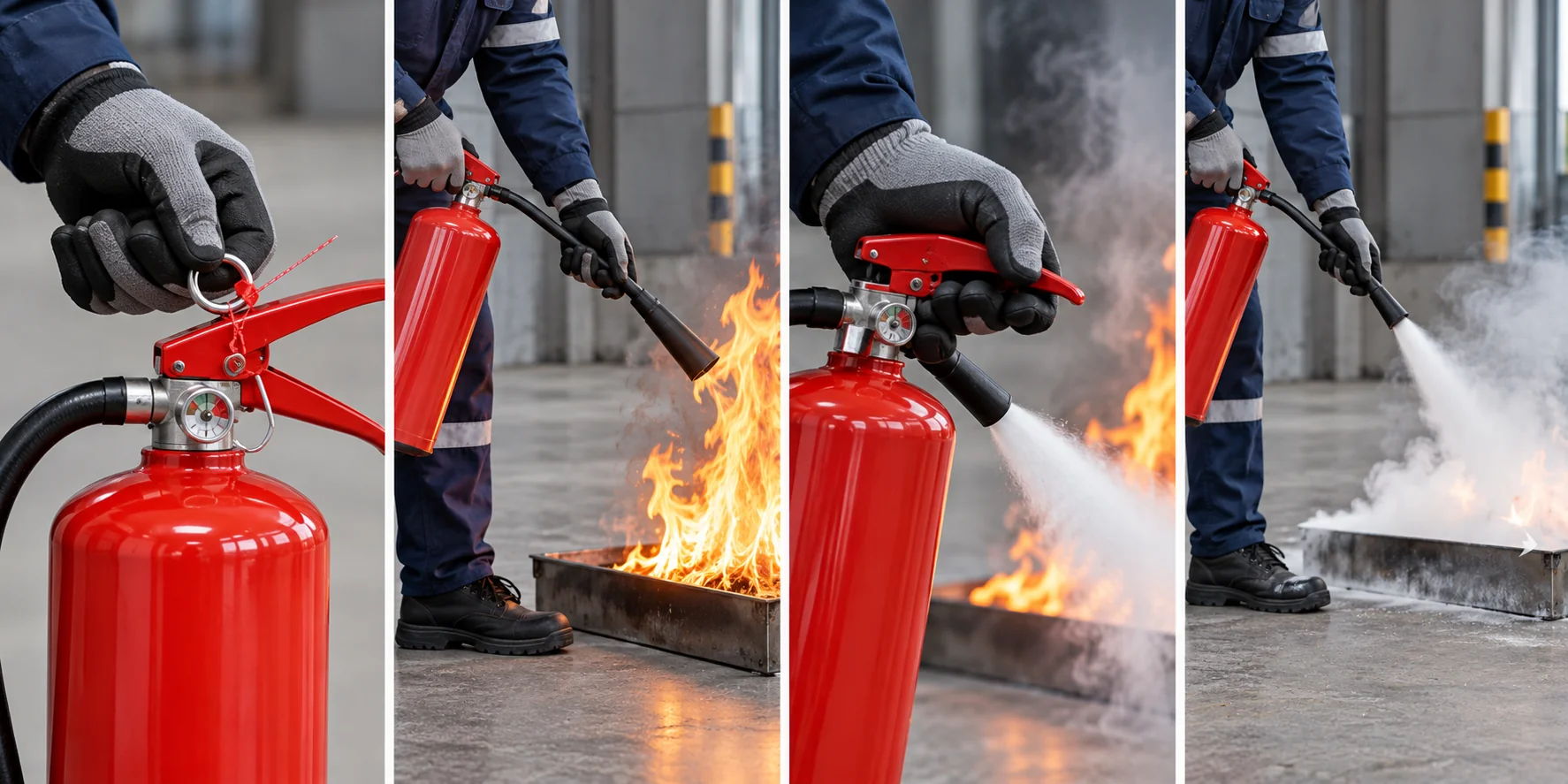
Extinguishers are rated for different fuel types. Using the wrong type can spread the fire or create a shock hazard. Check the extinguisher's rating label and your site's fire safety plan before you rely on it, and never use one you have not been trained on.
Source basis: OSHA requires that where portable fire extinguishers are provided for employee use, employers provide hands-on training in their general use upon initial employment and at least annually thereafter.
Alarms and evacuation
Alarm and notification systems
Know the location of the nearest manual pull station and how to activate it. Activating the alarm and notifying emergency services comes first, before attempting to fight even a small fire, so a wider response is already underway if the situation escalates.
Evacuation protocols
Leave promptly by the nearest safe route when an alarm sounds. Do not stop to collect belongings.
Report to your assembly area and take part in the accountability check so responders know who is accounted for and who may still be inside.
Do not re-enter the building until a competent authority confirms it is safe to do so.
Try itThe fire alarm sounds while you're halfway through a report and you can't see or smell anything. Your usual exit is the main stair. What do you do?
Every minute spent collecting things is a minute you could be in smoke. Treat every alarm as real until a competent person says otherwise.
Right. Leave promptly, don't collect belongings, and take part in the accountability check so responders know who is still inside.
You'd be walking towards the danger while everyone else walks away from it, and the head count would be wrong. Reporting and evacuating come first.
Source basis: The ILO Fire Risk Management Manual calls for at least two independent exit routes so workers are not trapped if one route is blocked. OSHA's Emergency Action Plan requirements (29 CFR 1910.38) call for clear exit routes and assigned emergency duties.
Global regulatory frameworks
Fire safety duties are set out differently across jurisdictions, but the same underlying principles, prevention, detection, safe egress and training, repeat across all of them.
OSHA (United States)
Under 29 CFR 1910.38 (Emergency Action Plans) and 29 CFR 1910.39 (Fire Prevention Plans), employers must maintain clear exit routes and assign emergency duties. Where portable fire extinguishers are provided for employee use, OSHA requires hands-on training upon initial employment and annually thereafter.
ILO (International)
The ILO Fire Safety Guidelines require that all employees receive basic fire prevention training during their initial induction. The ILO Fire Risk Management Manual mandates at least two independent exit routes to prevent workers from becoming trapped.
EU-OSHA (European Union)
Directive 89/654/EEC (Workplace Requirements) requires employers to optimize emergency routes, maintain functional fire detection, and conduct mandatory regular fire drills. In some European countries, such as Germany, a specific proportion of the workforce must be certified as designated Fire Protection Assistants (Brandschutzhelfer).
Official references
Final assessment
The assessment has ten questions. A verified learner must complete all lessons and score at least 80%. A certificate confirms completion and the recorded knowledge score. It does not certify practical competence or authorize fire safety duties.
Question 1 of 10