request an outage
Level 2 · Practitioner · Self-paced
Electrical Substation Safety
Recognise the electrical and non-electrical hazards of a high-voltage substation and the controls that prevent fatalities: isolation, verification, protective earthing, safe approach, PPE chosen from the hazard assessment, and the discipline to stop when anything is unclear.
0% complete
What this course is, and is not
This Level 2 course gives safety knowledge for people who work in and around high-voltage substations: engineers, supervisors, HSE practitioners, contractors and technicians. It does not authorise anyone to perform HV switching, work on energised HV conductors, apply or remove HV protective earths, perform live-line work, issue electrical safety documents, alter protection systems, defeat interlocks or enter restricted electrical zones. Those activities need additional technical competence, practical training, formal authorisation by the employer and compliance with the applicable electrical safety rules. Local legislation, network operator rules and the asset owner’s electrical safety rules take precedence where they are stricter.
Understanding the substation
An electrical substation is the part of the power system that transforms voltage, switches circuits, protects equipment, controls power flow and provides isolation. Some substations are small distribution sites that feed a town, a building or a factory. Others are large transmission or subtransmission sites that link power stations and regional networks. The safety principles in this course apply to all of them, but approach distances, equipment ratings and the detailed rules change with the voltage.
A rating such as 33/11 kV gives the nominal phase-to-phase voltages on each side of the substation’s transformers. At high voltage, dangerous electrical effects can happen without touching anything: electricity can flash over through air when someone, or something they carry, comes too close. The higher the voltage, the greater the distance that has to be kept.
Explore the switchyard
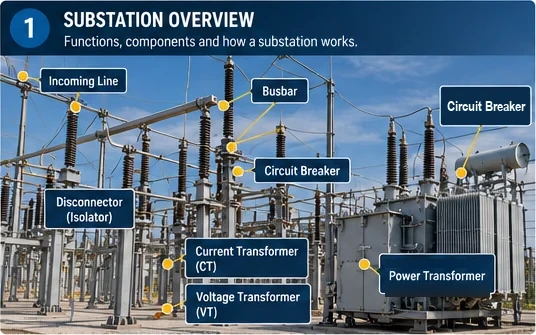
Look at the picture, then tap each labelled item to see what it does and the safety point that goes with it.
1 / 7
Incoming line
Brings power in from the transmission network. Safety point: it can be energised from the remote end, and a parallel line can induce voltage on it even when it is disconnected.
Busbar
The common conductor that connects circuits together. Safety point: when one busbar is isolated, a parallel or adjacent busbar may still be live a few metres away.
Disconnector (isolator)
Provides visible or defined isolation within its design function. Safety point: it is not automatically able to break load or fault current, so it is only operated as the switching procedure allows.
Circuit breaker
Interrupts normal and fault current. Safety point: it can be operated remotely and stores spring, hydraulic or pneumatic energy. An OPEN indication alone does not make anything safe.
Current transformer (CT)
Measures current for protection and metering. Safety point: opening an energised CT secondary circuit can produce dangerously high voltage.
Voltage transformer (VT)
Steps the voltage down for protection and metering. Safety point: a test set or a fault on the secondary side can backfeed the primary.
Power transformer
Changes the voltage between two networks. Safety point: either side can be a source, and it holds large amounts of combustible insulating oil.
More than you can see
A substation also contains systems that are easy to overlook but can still energise equipment or injure people. Open each group.
1 / 5
Control, protection and communications
Protection relays, control and protection panels, SCADA and telecommunications. These systems can operate plant remotely or automatically, including automatic reclosing.
Auxiliary supplies
Station service transformers, DC battery systems and UPS units. They keep control and protection alive when the main circuits are dead, and they are energy sources in their own right.
Earthing and surge protection
Earthing switches, the earthing grid and surge arresters. Surge arresters stay connected to the HV system and can remain energised when nearby equipment is isolated.
Reactive power equipment
Reactors and capacitor banks. Capacitors can hold a dangerous charge after disconnection.
Fire protection
Detection and suppression systems that protect transformers and buildings, with their own controls and hazards.
Every substation is different. Always work from the approved and current single line diagram for the actual installation, not from memory or from a similar site.
AIS or GIS?
Air insulated substation (AIS)
Clearance is provided mainly by air, so phases and live conductors are widely separated from earthed structures. Main hazards: approaching exposed conductors, induced voltage, weather, wildlife, mobile equipment and accidental encroachment.
Gas insulated substation (GIS)
HV equipment sits inside earthed metal enclosures filled with insulating gas or a gas mixture. It is far more compact, but adds hazards from the gas system, pressure, internal faults, enclosed equipment and specialised maintenance. IEC 62271-203 covers gas insulated metal-enclosed switchgear above 52 kV.
Hybrid substation
Combines air insulated and gas insulated equipment, so the hazards of both apply, sometimes within the same bay.
Your callA visitor asks which hazard is more specific to a GIS than to an AIS. What do you tell them?
That is mainly an AIS hazard, where conductors are open to the air.
Correct. Compact enclosures bring gas handling, pressure and internal fault hazards that an AIS does not have in the same form.
In a GIS the live parts are inside earthed enclosures. Exposed conductors are the characteristic AIS hazard.
No. Cable terminations, connections, auxiliary systems and fault conditions can all still cause shock.
Knowledge checkA colleague says the switchyard is safe to walk through "as long as nobody touches anything". Is that right?
No. At high voltage, electricity can flash over through air when a person, tool, ladder or vehicle comes within the minimum approach distance. That is why substations are controlled areas with authorised access, escorts and defined boundaries.
Electric shock and flashover
Electricity can kill or seriously injure through electric shock, burns, arcing, fire and explosion. A professional substation risk assessment has to look well beyond shock.
The hazard map
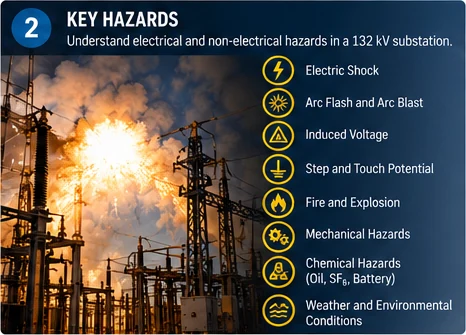
These are the eight hazard groups this course covers. Tap each one to see what it means and where you will meet it again.
1 / 8
Electric shock
Current flowing through the body. At high voltage the main defence is never being exposed. Covered in this lesson.
Arc flash and arc blast
Heat, light, molten metal and a pressure wave from an electrical fault. Lesson 3.
Induced voltage
Dangerous voltage on a disconnected conductor caused by nearby live circuits. Lessons 6 and 9.
Step and touch potential
Voltage differences across the ground or between a structure and your feet during a fault. Lesson 6.
Fire and explosion
Transformer oil, cables and batteries can burn or explode. Lessons 8 and 11.
Mechanical hazards
Stored spring, hydraulic and pneumatic energy, moving parts and lifting. Lessons 8 and 9.
Chemical hazards
Transformer oil, battery electrolyte, SF6 and its decomposition products. Lesson 7.
Weather and environment
Lightning, rain, ice, wind, heat and poor visibility change every other risk. Lesson 10.
What current does to the body
Tap each effect. Several of them can happen at once.
1 / 7
Muscular contraction
Muscles clamp involuntarily, so a person may be unable to let go, or may be thrown.
Respiratory arrest
Current through the chest can stop breathing.
Ventricular fibrillation
The heart quivers instead of pumping. Without CPR and defibrillation this is fatal within minutes.
Cardiac arrest
The heart stops completely.
Internal tissue damage
Current destroys tissue along its path, often far more than the skin shows.
Severe burns
At entry and exit points, and from clothing set alight.
Secondary injuries
Falls from height or uncontrolled movement after the shock.
At high voltage, avoiding exposure is the primary defence
PPE must never be treated as permission to contact HV equipment. Nothing a person wears makes touching an energised HV conductor safe.
Flashover: no touch needed
At high voltage, electrical energy can bridge an air gap if a person, tool, crane, ladder, scaffold, conductor or other object comes too close to live equipment. That is why electrical approach boundaries and minimum approach distances are fundamental controls. The permitted distance comes from the applicable electrical safety standard and the site’s engineering requirements.
Your callA scaffolder is carrying a 6 m aluminium tube upright across an energised switchyard. Nobody is touching a conductor. What is the risk?
Contact is not needed. The tube can enter the minimum approach distance and flashover can occur through the air.
Correct. Long conductive objects must never be carried upright through an energised switchyard unless the route and method are specifically planned and controlled.
Weather can make things worse, but flashover is possible in dry conditions too.
Gloves do not prevent flashover from a tube, and they never replace keeping the approach distance.
Knowledge checkA supervisor estimates that a ladder will be "well clear" of a live busbar. Is that acceptable?
No. Never estimate a clearance by eye. Approach distances come from the electrical safety rules and site engineering, and they are measured and controlled, for example with barriers and a competent person checking the set-up.
Arc flash and arc blast
An arc flash is an electrical discharge through air or another medium, between conductors or between a conductor and earth. It is a separate hazard from electric shock: protecting someone from shock does not automatically protect them from an arc.
What an arc releases
Tap each output of an arc. Each one needs its own control.
1 / 9
Extreme heat
Thermal energy high enough to cause severe burns and ignite ordinary clothing.
Intense light
Can damage eyes.
Molten metal
Droplets of vaporised and melted conductor are thrown out.
Hot gases and fire
Expanding hot gases and flames, which can ignite nearby materials.
Toxic decomposition products
Burning insulation and, in gas equipment, decomposed insulating gas.
Pressure wave
The arc blast, described below.
Flying fragments
Parts of the equipment can be thrown out like shrapnel.
Severe noise
An intense impulse that can damage hearing.
Equipment destruction
The equipment itself may be wrecked, adding to the hazards around it.
Shock protection and arc protection are different
Match each control to what it actually does.
Control
What it does
0 of 4 matched
Arc blast
A high-energy fault rapidly heats and expands air and vaporised material. Tap each consequence of the pressure wave.
1 / 5
Thrown workers
The blast can throw a person off their feet or off a platform.
Ruptured eardrums
The pressure impulse can burst the eardrum.
Flying fragments
Pieces of equipment are propelled outward.
Lung damage
Blast pressure can injure the lungs.
Doors and panels
Enclosure doors and covers can be blown open violently.
So arc protection is about far more than clothing. Distance, equipment condition, fault clearing time, remote operation, maintenance and safe work practices all change the outcome.
A critical high-voltage point
Your callAn engineer runs a commercial IEEE 1584 arc flash calculator for a transmission bay that operates well above 15 kV and wants to choose PPE from the result. What should happen?
IEEE 1584 calculation models cover three-phase AC systems from 208 V to 15 kV. This bay is far outside that range.
Correct. Arc flash assessment above 15 kV needs an engineering method appropriate to the voltage and configuration. US OSHA also sets out different methods for systems above 15 kV.
A margin on an invalid calculation is still invalid. The model does not apply at this voltage.
PPE must never be chosen from voltage alone.
Rule
Never choose arc flash PPE from voltage alone. Select it from a documented hazard assessment or engineering study.
Knowledge checkA worker is wearing a full arc flash suit. Are they protected from electric shock?
No. Arc rated clothing protects against the thermal effects of an arc. It is not electrical insulation, and it does not make contact with live equipment safe.
Controlled access, competence and planning
HV substations are controlled electrical areas. Access is restricted according to each person’s competence and authorisation. US OSHA, for example, requires access to areas with exposed live parts to be controlled and limits entry to energised supply equipment areas to qualified persons.
Who may do what
Organisations use different names, but people generally fall into categories like these. Open each one, from least to most authority.
1. Visitor
No electrical responsibilities. Needs authorisation to enter and appropriate supervision throughout.
2. Instructed person
Has received enough information about electrical hazards for defined activities, but is not authorised to carry out HV electrical work.
3. Qualified electrical person
Has the electrical knowledge, training and demonstrated ability to recognise and avoid electrical hazards.
4. Authorised person
Has formally delegated, written authority for defined electrical activities.
5. Senior authorised person or switching authority
Depending on the organisation’s safety rules, may be responsible for switching, isolation, safety documents and operational control.
1 / 5
Training alone does not create authorisation
Completing a course, including this one, gives knowledge. Only the employer, under its electrical safety rules, can authorise someone to do HV work.
Your callYou have just completed this course. The switching authority is running late, and your supervisor asks you to operate an HV disconnector "to save time". What do you do?
You are not authorised. Switching is controlled by the safety rules and a switching programme, not by labels.
Correct. Time pressure is a classic precursor to serious electrical incidents. The answer stays the same however late the job is running.
Remote guidance does not make you authorised or competent for HV switching.
PPE does not authorise anyone. It is the last layer of protection, not a permit.
Plan before you start
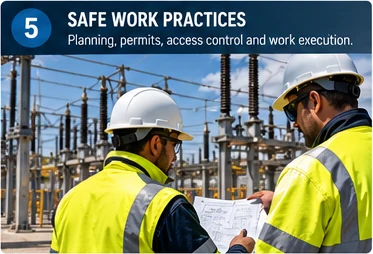
Every task starts with planning. Step through the questions the responsible team must answer before work begins.
1. The equipment and the system.
The equipment and the system. What equipment is involved, and what is the system operating condition? What adjacent equipment stays energised?
2. Every source of energy.
Every source of energy. All possible electrical sources, remote control, automatic reclosing, backfeed, stored electrical energy, induced voltage and stored mechanical energy.
3. Isolation and earthing.
Isolation and earthing. Which isolations and which protective earths are required, and which safety boundaries apply?
4. People and equipment.
People and equipment. Required PPE, tools and test equipment, and the competence and authorisation of everyone involved.
5. Coordination.
Coordination. Communication arrangements, other activities happening at the same time, and emergency arrangements.
6. Conditions.
Conditions. What is the weather doing now, and what will it do during the job?
1 / 6
The paperwork
Depending on the organisation, the work may need some of these documents. Names and exact uses vary between safety rules, so tap each for its general purpose.
Risk assessment and job safety analysis
Identify the hazards of this task and the controls for each step.
Method statement
Describes how the work will be done, in sequence.
Switching schedule
The approved sequence of switching operations to achieve isolation.
Permit to work
Formal authority to work on equipment once it has been made safe.
Limitation of access
Defines limits for work near, but not on, HV equipment.
Isolation certificate
Records the isolations and locks in place.
Sanction for test
Controls testing that needs conditions a work permit would not allow.
Earthing schedule
Records where protective earths are applied and removed.
Energised work permit
Required where justified energised work is planned. It never authorises contact with energised HV conductors.
Lifting plan and excavation permit
Control cranes and digging inside the substation.
Documents do not make anything safe by themselves
The field condition must match the documentation. If it does not, stop.
Knowledge checkThe permit is signed, but the earth shown on the earthing schedule is not on the equipment. Can work start?
No. The permit describes a condition that does not exist in the field. Stop and resolve the discrepancy with the person in control before anyone works on the equipment.
Isolation, LOTO and operational control
Turning equipment "OFF" is not the same as making it safe. A circuit breaker showing OPEN does not, on its own, prove that the equipment is electrically safe.
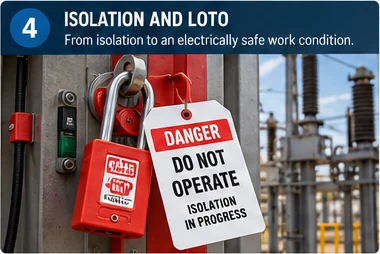
Eight steps to a safe work condition
Before electrical equipment can normally be treated as dead, the safety process must cover all eight steps. Step through them in order.
Identify the correct equipment. Confirm the circuit, bay and equipment against the current single line diagram and the labels in the field.
Identify every possible energy source. Including backfeed, auxiliary supplies and induced voltage, not just the main supply.
Disconnect or isolate. Open the isolation points defined in the switching programme.
Prevent reconnection. Lock and tag the isolation points and control remote and automatic operation.
Verify that the equipment is dead. Using approved methods and equipment suitable for the voltage, by authorised people.
Apply protective earths where required. To protect against reenergisation and induced voltage.
Protect against adjacent live equipment. Barriers, boundaries and approach distance controls.
Formally release the equipment for work. Through the safety document, so everyone knows exactly what is safe and where.
1 / 8
US OSHA states that equipment that does not meet the required deenergising conditions must be treated as energised. That is a good rule everywhere.
Where else can energy come from?
A professional isolation assessment looks for unexpected sources. Tap each one.
Incoming supply and parallel circuits
More than one route can feed the same equipment.
Backfeed through transformers
Voltage applied to one side of a transformer appears on the other.
Generators and auxiliary supplies
Standby generators and station supplies can energise circuits.
Control voltage and batteries
Control circuits often stay live from the DC battery after the main circuit is isolated.
Instrument transformers
VT and CT secondary circuits, and test sets connected to them, can backfeed.
Capacitors
Retain a charge after disconnection.
Induction from adjacent circuits
Live parallel lines and busbars induce voltage on dead conductors.
Static charge
Long conductors and cables can hold a static charge.
Stored mechanical energy
Springs, hydraulics and compressed air in operating mechanisms.
Remote and automatic operation
Remote control, automatic switching and automatic reclosing can operate plant without anyone on site.
Never rely on one indication alone
SCADA shows the circuit OFF
A screen shows what the system thinks. Indication can be wrong, delayed or refer to the wrong item.
The position indicator says OPEN
Mechanical indicators and linkages can fail or be misread.
Someone tells you it is dead
A statement is not verification, however experienced the person is.
Lockout/tagout and operational control
LOTO prevents unexpected operation or energisation. In HV substations it is usually part of an electrical safety rules system rather than conventional machinery LOTO. Use this list to check your own site’s procedure: does it state clearly who can...
prepare a switching programme
perform switching
verify isolations
apply operational locks
apply safety tags
apply protective earths
issue permits
receive permits
cancel permits
release equipment for energisation
Golden rule
No one should assume equipment is safe because another person operated a switch. The complete safety system must be in place.
Your callA technician is told that an HV circuit breaker has been opened remotely and wants to start maintenance on it. Is it safe to work on?
An OPEN indication alone does not establish a safe work condition.
SCADA indication is not verification and does not prevent reclosure.
Correct. And because a breaker stores mechanical energy, its mechanism must also be made safe before maintenance.
PPE does not create a safe work condition.
Knowledge checkWhy must remote control and automatic reclosing be dealt with as part of isolation?
Because they can operate plant with nobody on site touching it. Unless they are disabled, locked out or otherwise controlled under the safety rules, equipment that looks isolated can be re-energised from a control room or by protection.
Verification, protective earthing, step and touch potential
Verify that it is dead
Testing for absence of voltage is a critical safety activity. On HV equipment it is only carried out by specifically trained and authorised people. Tap each requirement.
1 / 5
Equipment suitable for the system voltage
An HV voltage detector rated for the system, checked before and after use as the procedure requires.
Approved testing methods
The test method and test points are defined by the electrical safety procedure, not chosen on the day.
Approved insulating tools
Where required, such as insulating sticks for applying the detector.
Specified electrical PPE
As set out in the procedure and hazard assessment.
Established approach controls
The tester keeps the required distance from other live parts throughout.
Your callA technician offers to "quickly check" an HV conductor with a good-quality multimeter. What do you say?
CAT ratings apply to low-voltage measurement. No LV meter is an HV voltage detector.
Correct. Only approved HV detection equipment, used by an authorised person with the defined method, may be used.
Gloves do not make an unsuitable instrument safe.
That habit reduces some LV risks. It does nothing on HV equipment, where the instrument itself is the problem.
Why isolation alone is not enough
Equipment that has been disconnected can become live again. Tap each way it can happen.
1 / 8
Incorrect switching
The wrong item is operated.
Accidental switching
Someone operates a switch by mistake.
Remote operation
A control room or automatic scheme closes a breaker.
Backfeed
Through transformers, VTs or another circuit.
Generator connection
A standby or temporary generator is connected.
Induced voltage
From adjacent live circuits.
Lightning
Strikes on lines or structures nearby.
Equipment failure
Insulation breakdown or mechanical failure.
Protective earthing adds a further layer. US OSHA explains that protective grounds can create equipotential conditions and protect against induced voltage, accidental reenergisation and unexpected backfeed.
The equipotential zone
An equipotential zone keeps conductive objects in the work area at the same potential, so there is no dangerous voltage difference for a worker to bridge. An earthed structure does not automatically mean zero hazard: during an earth fault, very large currents can flow through the earthing system.
Touch and step potential
Tap each to see the definition. Then match the terms below.
Touch potential
The voltage difference between an earthed structure or object a person is touching and the ground beneath their feet.
Step potential
The voltage difference between two points on the ground separated by the distance between a person’s feet.
Where gradients appear during a fault
Around transformers, structures, towers, earthing points, cranes, vehicles and damaged conductors.
How the risk is reduced
Earthing grids, equipotential zones, insulating methods and restricted work areas, all recognised by OSHA as measures against hazardous potential differences.
Term
Meaning
0 of 4 matched
Knowledge checkThe equipment has been verified dead. Why apply protective earths as well?
Because verification only shows that it is dead now. Earths protect against what could happen next: wrong or remote switching, backfeed, induced voltage, lightning or equipment failure.
Personal protective equipment
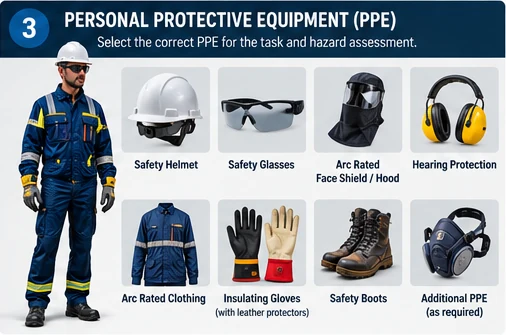
PPE is the final layer
Electrical PPE is essential, but it never replaces the controls above it. European workplace law likewise puts PPE after collective and organisational measures. Open each layer, from strongest to weakest.
1Remove the hazard
Deenergisation, isolation and protective earthing.
2Keep people and energy apart
Safe distance, barriers, interlocks and remote operation.
3Control the work
Approved work procedures and competent supervision.
4PPE
The final layer, for the risk that remains after everything above.
Kit up
Tap each item to see the key point for substation work.
1 / 8
Safety helmet
Approved industrial helmet, compatible with arc flash face protection, hearing protection and a chin strap where needed. An electrically rated helmet does not make contact with HV conductors safe.
Eye protection
Safety glasses with side protection wherever eye hazards exist, and often worn under an arc rated face shield or hood.
Arc rated clothing
Shirt, trousers, coverall, jacket, flash suit, balaclava or hood, with an arc rating appropriate to the assessed exposure. Ordinary flame resistant clothing is not automatically equivalent to arc rated clothing.
Face and head protection
Arc rated face shield, balaclava or hood as the arc assessment requires, with a rating appropriate to the assessed thermal exposure.
Hearing protection
An arc produces intense impulse noise, so hearing protection may be part of the arc flash ensemble.
Safety footwear
Meets site requirements for impact, penetration, slip resistance and, where specified, electrical hazard. Treat electrical footwear as supplementary: it never replaces isolation, earthing or distance.
Insulating gloves
Comply with a recognised standard such as IEC 60903, correct class, inspected before every use, within their test period, stored correctly and removed from service if damaged or suspect.
Leather protectors
Worn over rubber insulating gloves to protect them from cuts, punctures and abrasion. The protector is not the electrical insulation.
Critical HV warning
US OSHA recognises rubber insulating gloves up to Class 4, with a maximum AC use voltage of 36 kV. No rubber glove is rated above that, and many substation busbars and lines run far higher. Even within a glove’s rating, glove work on HV is live working: only specifically trained and authorised people do it, under the electrical safety rules, with the correct class of glove, tested and in date. At transmission voltages, energised work needs specialised methods, tools, distances, engineering controls and competence. No glove should ever create a false sense of security.
Your callA worker suggests wearing Class 4 rubber gloves "for extra protection" while approaching a live HV busbar. What do you do?
The highest class still has a maximum use voltage of 36 kV, and no glove replaces the approach controls.
Wearing two pairs does not create a higher rating.
Correct. The approach itself is the problem: it needs the controls of the electrical safety rules, not gloves.
Leather protectors protect the rubber from damage. They are not insulation.
Beyond electrical PPE
Chemical PPE
Transformer oil, battery electrolyte, cleaning chemicals, gas decomposition products and fire suppression chemicals. Select from the chemical hazard assessment and the Safety Data Sheet: chemical resistant gloves, goggles, face shield, apron and suitable clothing.
Battery work
Station batteries present DC energy with very high short-circuit current, chemical exposure, heat, hydrogen and explosion risk. Typical controls: electrical and chemical risk assessment, eye and face protection, chemical resistant gloves and apron, insulated tools and no conductive jewellery.
SF6 and other insulating gases
Normally contained gas and gas released after an internal fault are very different situations. Gas work may need controls for pressure, decomposition products, oxygen displacement, contaminated dust and emissions, and PPE up to respiratory protection. Only trained people handle gas or contaminated GIS maintenance.
Work at height
Harness, compatible lanyard or fall arrest, suitable anchorage and a rescue plan. Fall protection must never create an electrical encroachment hazard.
Task and PPE thinking
Match each task to the PPE considerations in the course matrix. The matrix is educational only. It does not replace a task-specific PPE assessment.
Task
Typical PPE considerations
0 of 4 matched
Knowledge checkA contractor turns up in a flame resistant coverall and says it is "the same as arc rated". Is it?
Not automatically. Arc rated clothing has a tested arc rating that must match the assessed exposure. Check the label and the PPE assessment, not the description.
Equipment-specific hazards
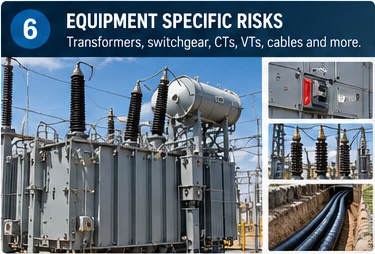
Each type of equipment has hazards of its own. Open each one.
1 / 8
Power transformers
HV bushings, lower-voltage bushings that stay energised, backfeed, transformer oil, fire and explosion, cooling fans and pumps that start automatically, high noise, hot surfaces and tap changer mechanisms. Never assume the HV side is safe because the LV side is disconnected, or the other way round.
Circuit breakers
Store spring, hydraulic or pneumatic energy and electrical control energy, and can be operated remotely. Maintenance must control both the electrical and the mechanical stored energy.
Disconnectors and isolators
Provide visible or defined isolation within their design function, but are not automatically able to interrupt load or fault current. Operate them only for their intended duty and by the approved switching procedure.
Earthing switches
Provide earthing within the switchgear. Understand their position, capability and interlocking before relying on them. Only authorised people operate HV earthing switches.
Current transformers (CTs)
An energised CT secondary circuit must never be accidentally opened: dangerously high voltage can develop. Only competent electrical staff modify CT secondary circuits.
Voltage transformers and CVTs
Consider the primary HV connection, secondary voltage, fuses, backfeed, residual energy and isolation. Secondary injection or test equipment can introduce unexpected voltage, so testing is part of the isolation assessment.
Capacitors
Can keep a dangerous charge after disconnection. Follow the manufacturer’s discharge time and the safety procedure. Isolation alone does not prove the stored energy has gone.
Surge arresters
Connected to the HV system and may remain energised when nearby equipment is isolated. Verify their condition and connection before work.
Match the hazard
Equipment
Key hazard
0 of 5 matched
Your callA technician wants to disconnect a wire from the secondary circuit of a CT while the primary circuit is carrying current. What is the right response?
The secondary is low voltage only while its circuit is closed. Opening it can create a dangerous voltage.
Correct. CT secondary work follows a defined procedure, for example shorting the secondary correctly before any disconnection, carried out by competent staff.
Gloves do not address the hazard of opening the circuit.
Time does not change the hazard. The procedure does.
Knowledge checkThe LV side of a transformer has been disconnected. Is the HV side now safe?
No. Every possible source must be considered and isolated separately. The HV side may still be connected to the HV network, and backfeed can energise either side.
Induced voltage, cranes and work at height
Induced voltage
One of the most underestimated HV hazards. A disconnected conductor can develop a dangerous voltage because of nearby live circuits, so a conductor that is isolated can still be hazardous. Tap each source.
1 / 5
Electromagnetic induction
Current in a nearby live circuit induces voltage along a parallel dead conductor.
Capacitive coupling
A dead conductor near a live one picks up voltage through the air between them.
Parallel transmission lines
Long parallel runs make induction much stronger.
Adjacent busbars
A live bus beside the isolated one.
Temporary cable arrangements
Temporary cables laid near live circuits.
Protective earthing, bonding and equipotential working are the key controls.
Your callOne busbar has been isolated and earthed, but the parallel busbar is still live. Which statement is right?
Isolating one bus does not remove the hazards created by the adjacent live one.
Correct. The adjacent live bus defines most of the risk in this job.
Induced voltage is one hazard. Clearances, movement, tools and access routes matter as much.
Everyone in the work area must know where the live equipment and boundaries are.
Cranes and mobile plant
Cranes in an energised substation bring serious risks. Tap each hazard.
1 / 7
Boom encroachment
The boom enters the electrical clearance.
Suspended loads
The load or rigging swings towards live conductors.
Induced voltage
Long booms can pick up induced voltage.
Energised machine
A flashover makes the whole crane and anyone touching it live.
Ground potential rise
Dangerous voltage gradients around the crane during a fault.
Loss of visibility
The operator cannot judge distances to conductors.
Uncontrolled load movement
Wind or a snag swings the load.
Use the checklist to plan a lift. The suspended load is part of the lifting system when you assess electrical clearance.
Lift plan prepared and approved
Electrical clearance review completed for boom, rigging and load
Exclusion zone set up
Competent lifting team in place
Designated spotter appointed
Boom restriction used where appropriate
Travel routes clearly identified
Electrical isolation arranged where necessary
Your callA crane will remove an accessory from an isolated transformer. The nearby busbar is still live. What must the lift assessment cover?
The transformer being isolated does not make the switchyard safe.
Correct. Assess the worst-case position of every part of the lifting system, not the planned one.
Weight matters for the crane, but the electrical hazard is about geometry and clearance.
Weather is one input, not the whole assessment.
Ladders, scaffolds and work at height
Metal ladders, scaffold tubes, long tools and materials can create an electrical path. Step through what must happen before work at height.
Identify energised equipment around and above the work position.
Verify the required electrical clearances for people, tools, materials and the access equipment itself.
Establish physical controls such as barriers and defined access routes.
Assess dropped object risk including onto live equipment below.
Establish fall protection that does not create an encroachment hazard.
Plan rescue before anyone goes up.
Control materials and tools especially anything long or conductive.
1 / 7
Long objects
Never carry long objects upright through an energised switchyard unless the move has been specifically planned and controlled.
Knowledge checkWhy is induced voltage described as "underestimated"?
Because the conductor has been correctly isolated, so people assume it is dead. Induction can still put a dangerous voltage on it, which is why earthing and equipotential working are needed even after isolation.
Excavation, testing and weather
Excavation and underground cables
A substation is full of buried services: HV and LV cables, control cables, fibre optics, earthing conductors, fire systems, drainage and other utilities. Damaging an HV cable can cause a catastrophic arc and fire. Excavation should always need an approved permit. Check the controls.
Current drawings available
Cable survey completed
Cable locating equipment used
Services marked on the ground
Controlled digging techniques used
Supervision in place
Isolation arranged where required
Testing and commissioning
Testing creates conditions that can be very different from normal operation. Tap each hazard.
1 / 8
Temporary energisation
Equipment is made live for a test.
High test voltage
Test sets can produce voltages above the system voltage.
Temporary connections
Test leads and links that are not part of the normal installation.
Stored charge
Cables and capacitive equipment hold charge after a test.
Incorrect earthing
Earths removed for testing and not restored, or applied in the wrong place.
Removed interlocks
Interlocks bypassed for testing and left that way.
Test equipment backfeed
Test sets feeding back into other parts of the system.
Communication failure
The person at the test set cannot reach the person at the far end.
A test area should have all of these. US OSHA specifically requires safety checks around high-voltage testing, including barriers, safeguards, disconnects, earthing and PPE.
Clear control of the test area
Barriers
Warning signs
Defined responsibility
Emergency isolation
Controlled access
Weather
Outdoor HV work is affected by lightning, rain, ice, fog, snow, high wind, extreme heat and poor visibility. Tap to see what weather changes.
1 / 6
Insulation performance
Rain, fog and contamination reduce insulation and can change flashover behaviour.
Worker stability
Ice, wind and wet surfaces affect footing and work at height.
Crane operation
Wind moves booms and loads and sets limits for lifting.
Approach distance control
Wind-driven movement of conductors, ropes and loads makes clearances harder to hold.
Electrical testing
Wet conditions affect test results and the safety of test set-ups.
Earthing operations
Weather affects the safe application of protective earths.
Your callA thunderstorm is approaching while a team is about to apply protective earths in the switchyard. What should happen?
Rushing is a precursor to errors, and lightning is a reenergisation source.
Correct. Sites should set clear criteria for stopping outdoor electrical work in hazardous weather, and lightning is a direct hazard to people working on outdoor HV equipment.
Lightning can energise isolated equipment, and storms affect everything else on site too.
Clothing does not address lightning or the other weather effects.
Knowledge checkWhy are removed interlocks listed as a testing hazard?
Interlocks are often bypassed to allow a test. If they are not restored, the protection they give against wrong operation is missing when the equipment returns to service.
Emergency response
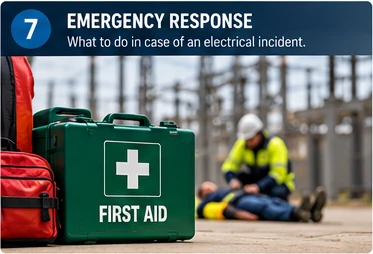
Someone is receiving an electric shock
Do not touch the casualty while they may still be energised
Electrical rescue from HV equipment is a specialised activity. Untrained rescuers become additional casualties.
Step through the response.
1. Raise the alarm.
Raise the alarm.
2. Start emergency isolation
Start emergency isolation through the authorised electrical response.
3. Call the emergency services.
Call the emergency services.
4. Keep others out
Keep others out of the danger area.
5. Start first aid, CPR or AED
Start first aid, CPR or AED only once the area is electrically safe.
1 / 5
Your callA colleague has collapsed against a VT structure and may still be in contact with it. Another worker runs towards them. What should you do?
Touching someone who may be energised can make you the next casualty.
Water conducts and does nothing to remove the electrical hazard.
Correct. Prevent further casualties first. First aid starts once the area is electrically safe.
Nobody should touch them until the area is confirmed electrically safe.
Arc flash injuries
Arc flash casualties may have several injuries at once. Activate the emergency response immediately.
1 / 7
Thermal burns
From the heat of the arc and burning clothing.
Electrical burns
Can involve serious internal injury even when the outside looks limited.
Eye injury
From intense light and molten metal.
Hearing injury
From the blast impulse.
Blast trauma
From the pressure wave and fragments.
Respiratory injury
From hot gases and toxic products.
Secondary impact injuries
From being thrown or falling.
Electrical fire
If electrical equipment is burning, step through the response.
Raise the alarm.
Start the site emergency response.
Inform the electrical control authority.
Establish electrical isolation where possible.
Keep everyone outside the danger area.
1 / 5
Firefighting on HV equipment
Do not apply firefighting media to energised HV equipment unless the equipment, the method and the people are specifically approved for it. Transformer fires can escalate quickly and may involve large quantities of combustible insulating oil.
Knowledge checkAn arc flash casualty has only small visible burns and says they feel fine. Do they still need medical assessment?
Yes. Electrical burns can involve serious internal injury even when the external burns look limited. Activate the emergency response and get them medical assessment.
Human factors, the pre-work check and five scenarios
Many serious electrical events do not start with a lack of technical knowledge. They start with ordinary human precursors. Tap each one.
Assumptions
"It must be dead, it was switched yesterday."
Poor communication
Instructions misheard or not repeated back.
Time pressure
The outage window is closing.
Normalised routine
A task done many times stops feeling dangerous.
Wrong equipment identified
The right work on the wrong bay.
Outdated drawings
The diagram no longer matches the site.
Interrupted switching
A phone call in the middle of a switching sequence.
Incomplete handovers
Shift change without a full briefing.
Confirmation bias
Seeing what you expect to see on an indicator.
Overconfidence
Experience used as a reason to skip a step.
Inadequate supervision
Nobody checking the critical steps.
Would you stop?
Each card is a real situation. Decide, then tap.
The bay label does not match the permit
Stop. Equipment identification is unclear.
The drawing shows an earth that is not on site
Stop. The documents and the field differ.
Your voltage detector gives an unexpected reading
Stop. Unexpected voltage means the condition is not what was assumed.
A barrier has been moved by another team
Stop. Boundaries must be restored and the change understood.
Another team changes the system conditions
Stop. Re-establish what is live and what is isolated.
Wind picks up while a crane is working
Stop if the weather changes the risk beyond the plan.
The correct arc rated hood is not available
Stop. The correct PPE is part of the plan.
The test equipment is damaged or out of date
Stop. Questionable test equipment cannot verify anything.
You lose contact with the control authority
Stop. Work under operational control needs communication.
You cannot confirm isolation or earthing
Stop. That is the condition the whole job depends on.
No schedule justifies bypassing electrical safety controls
Stopping is part of the job, not a failure to do it.
Before work checklist
Use this before entering the work area. If any critical item cannot be ticked, work must not begin.
Correct equipment identified
Current single line diagram available
Work scope understood
Responsible person identified
System condition confirmed
Risk assessment reviewed
Electrical hazards identified
Required electrical boundaries established
Isolations confirmed where required
Remote operation controlled
Automatic reclosing addressed
Backfeed considered
Stored energy considered
Induced voltage considered
Protective earthing established where required
Adjacent live equipment identified
Barriers installed
Correct PPE available
PPE inspected
Tools suitable and inspected
Test equipment suitable and in date
Weather acceptable
Emergency response understood
Communication method confirmed
Work authorisation valid
Five scenarios
You have met these scenarios in earlier lessons. Open each one to review the key lesson.
1. The open breaker
A breaker opened remotely is not safe to work on. Isolation, prevention of reconnection, verification, earthing and the safety document must all be in place.
2. The rubber gloves
Class 4 rubber gloves have a maximum AC use voltage of 36 kV. They are not permission to approach live HV parts. Stop the activity.
3. The adjacent live circuit
Isolating one busbar does not remove the hazards of the live one beside it: clearances, induced voltage, movement, tools, barriers, earthing and access routes.
4. The crane in the switchyard
Assess the full crane geometry, boom, rigging, load and possible movement against the exclusion zone. An isolated transformer does not make the switchyard safe.
5. The CT secondary
Opening an energised CT secondary can create a dangerous voltage. Stop, and use an approved procedure and competent people.
1 / 5
Remember
1. Identify
Identify the equipment.
2. Control
Control every energy source.
3. Verify
Verify the condition.
4. Earth
Earth where required.
5. Maintain
Maintain electrical clearance.
6. Use
Use the correct PPE.
7. Never
Never assume.
8. Stop work
Stop work when conditions are unclear.
1 / 8
Knowledge checkWhich is the more common root of serious electrical incidents: a lack of technical knowledge, or human precursors such as assumptions and time pressure?
Human precursors. Many serious electrical events happen to knowledgeable people who assumed, rushed, were interrupted or worked from outdated information. Electrical safety depends on competent people, reliable systems and disciplined execution.
Final assessment
The assessment has ten questions drawn from a bank of twenty and reshuffled for every attempt. A verified learner must complete all lessons and score at least 80%. The certificate confirms completion of this Level 2 course and the recorded score. It does not authorise HV switching, live work, application of HV earths, issuing safety documents or entry to restricted electrical zones; those need practical training and formal authorisation by the employer.
Question 1 of 10