The substance or process involved.
Level 1 · Free · Self-paced
COSHH Assessment
Control hazardous substances. Protect people. Create safer workplaces. Learn to identify, assess and control substances hazardous to health, and understand why the same substance can carry very different risk depending on how the work is actually done.
0% complete
Training boundary
This course provides general awareness and practical-application training. It does not replace task-specific COSHH assessments, competent occupational hygiene advice, manufacturer instructions, Safety Data Sheets, applicable workplace procedures, or specific legal and regulatory requirements. Your organization's COSHH arrangements must reflect the substances, processes, exposures and legal requirements that apply to your own workplace.
What COSHH protects you from
COSHH stands for the Control of Substances Hazardous to Health. It is the framework used across many workplaces to identify, assess and control substances that could harm the people who work with them or nearby. The underlying principle is simple: if a substance can harm someone's health, that risk must be assessed and controlled before work goes ahead.
What counts as a hazardous substance
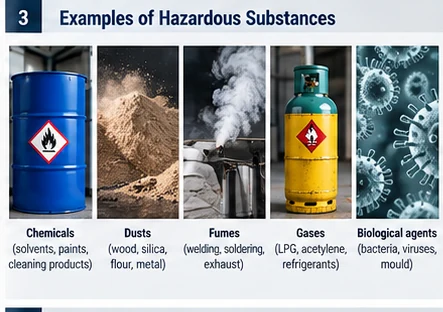
Hazardous substances are not only chemicals delivered in a supplier's container. They can also be generated by the work itself, and they take many physical forms:
1 / 7
Liquids
Solvents, cleaning products, paints and coatings.
Gases
Compressed gases such as LPG, acetylene or refrigerants.
Vapours
Given off by solvents or fuels at room temperature.
Dusts
Wood dust, silica, flour or metal dust from cutting, sanding or handling.
Fumes
Fine particles from welding, soldering or engine exhaust.
Mists
Fine liquid droplets from spraying operations.
Biological agents
Bacteria, viruses or mould encountered through work.
How hazardous substances affect the body
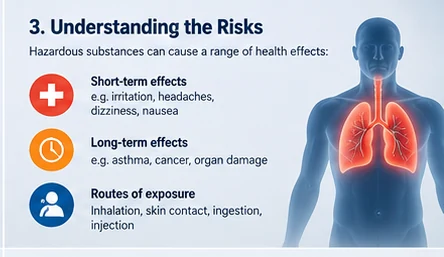
Health effects can appear immediately or only after repeated exposure over months or years:
Short-term (acute) effects
Irritation, headaches, dizziness, nausea or poisoning.
Long-term (chronic) effects
Occupational asthma, dermatitis, sensitisation, organ damage or cancer.
Routes of exposure
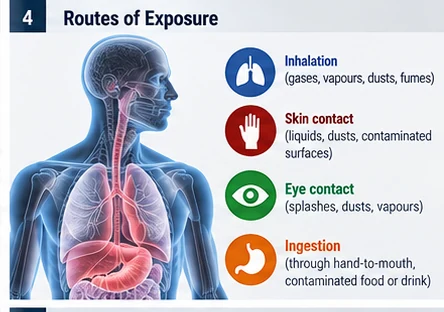
A substance can only harm someone if it reaches the body, and it can do that in more than one way:
1 / 5
Inhalation
Breathing in gases, vapours, dusts, fumes or mists.
Skin contact and absorption
Direct contact with liquids, dusts or contaminated surfaces.
Eye contact
Splashes, dusts or vapours reaching the eyes.
Ingestion
Hand-to-mouth contact, or contaminated food and drink.
Injection or puncture
A substance entering through broken skin, such as from a needle or sharp contaminated object.
Recognising which route applies to a task is the first step toward choosing a control that actually stops the exposure.
Task
Main route of exposure
0 of 4 matched
Labels, data sheets and the assessment process
Labels and Safety Data Sheets tell you what a substance can do. A COSHH assessment tells you whether that hazard is actually a risk in your specific task, and what to do about it.
Labels and hazard pictograms
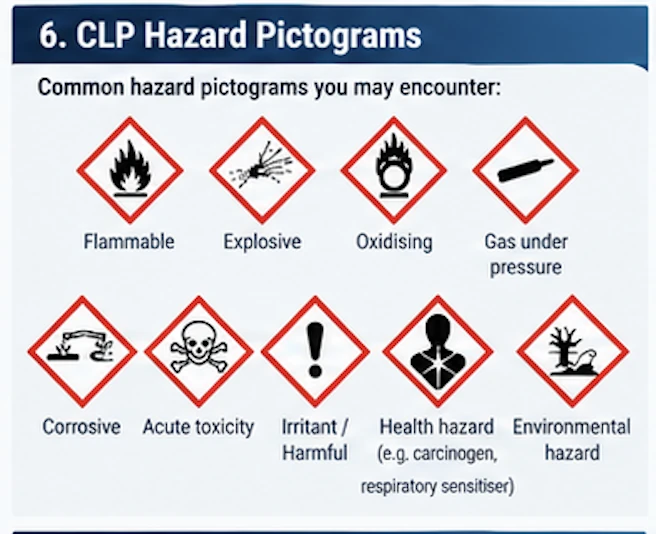
Product labels carry standardised CLP hazard pictograms under the Globally Harmonized System (GHS), along with a hazard statement (what the substance can do) and a precautionary statement (how to stay safe).
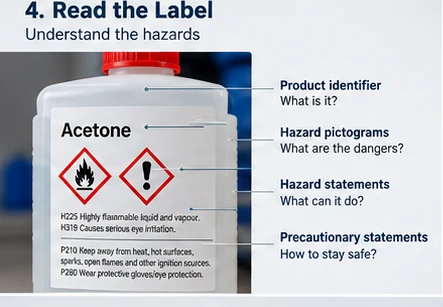
The same pictogram set is recognised internationally: flammable, explosive, oxidising, gas under pressure, corrosive, acute toxicity, irritant or harmful, health hazard (including carcinogens and respiratory sensitisers), and environmental hazard.
Safety Data Sheets (SDS)
A Safety Data Sheet is a longer, standardised document supplied with a substance, organised into a fixed set of sections covering identification, hazards, composition, first-aid measures, fire-fighting measures, accidental release measures, handling and storage, exposure controls and personal protection, physical and chemical properties, stability, toxicological and ecological information, disposal, transport and regulatory information.
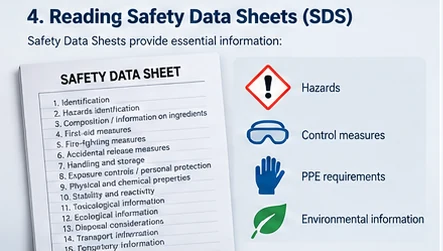
An SDS supports a COSHH assessment. It does not replace one: it describes the substance in general, but only an assessment of your actual task tells you how much of that hazard becomes a real risk for the people doing the work.
The COSHH assessment process
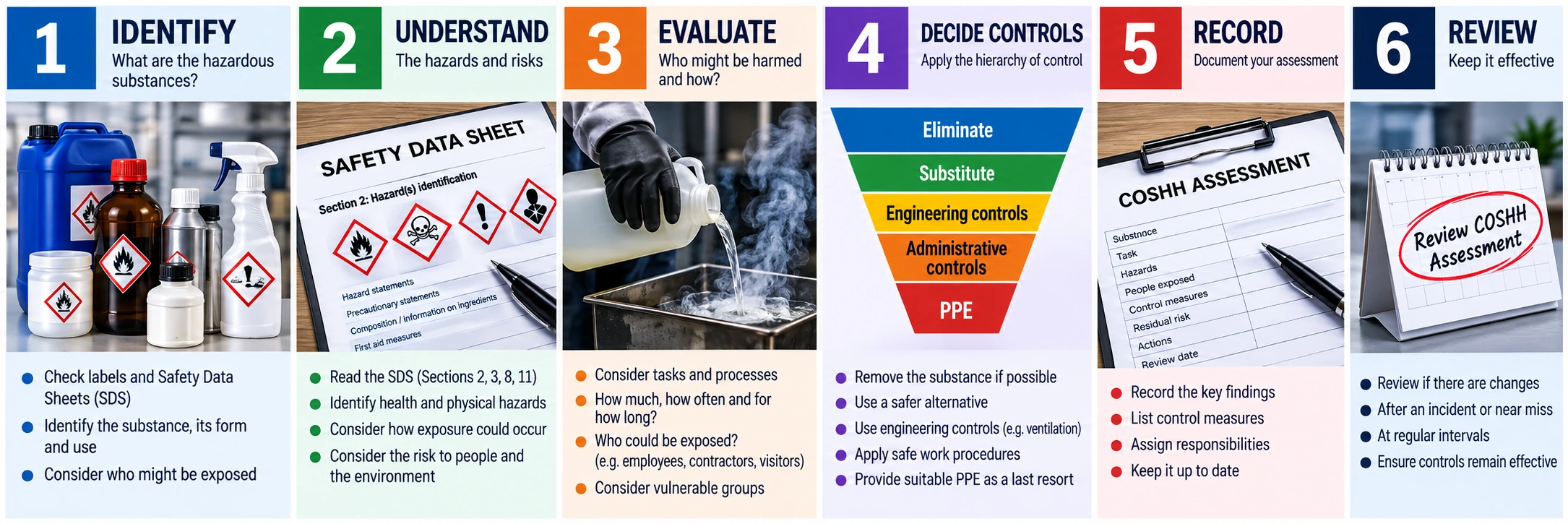
A COSHH assessment follows a practical sequence: Identify → Understand → Evaluate → Control → Record → Review. It examines the real workplace activity, not just the chemical container.
What is the substance, and where and how is it used?
What are its hazards, and how could exposure occur?
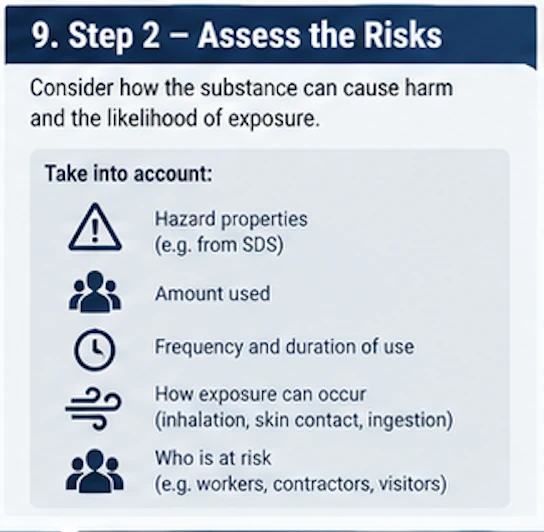
How much is used, how often, for how long, and who could be exposed?
Covered in the next two lessons.
Tap a stage to see what it covers.
Assessing exposure, not just the substance
Two people using the exact same substance can face very different risks, depending on the task. When evaluating exposure, consider the quantity used, how often the task occurs, how long exposure lasts, whether the process generates dust, vapour, fume, mist or spray, who could be exposed (including contractors, visitors or people working nearby), and whether existing controls are actually effective.
Same substance, different risk: a chemical stored in a closed container may present very little routine exposure. The same chemical sprayed, heated, poured or used in an enclosed space can create a significantly different risk. Always assess how the work is actually performed, not just what is written on the label.
Try itTwo technicians use the same solvent cleaner. One wipes small parts for a minute with the tin closed between uses. The other sprays it inside a small unventilated cabinet for an hour every day. Can they share one COSHH assessment?
The SDS describes the substance in general. The assessment is about the task: quantity, duration, frequency and how the substance is used change the exposure completely.
Right. Same substance, different risk. Spraying, heating or using a substance in an enclosed space can turn a minor exposure into a serious one.
Gloves address one route. The spraying task creates a major inhalation exposure that gloves do nothing for.
Selecting controls, PPE and safe storage
Once a hazard and its exposure route are understood, the next step is choosing controls that actually work, in the right order.
The hierarchy of control
1 / 5
1. Elimination
Remove the hazardous substance from the process entirely, if possible.
2. Substitution
Replace it with a less hazardous alternative.
3. Engineering controls
Local exhaust ventilation, enclosed systems, or containing the process itself.
4. Administrative controls
Safe systems of work, training, signage, and limiting exposure time.
5. Personal protective equipment (PPE)
The last resort, used when the controls above cannot adequately remove the risk on their own.
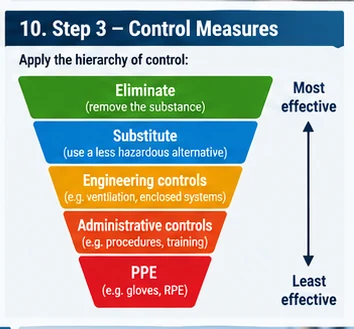
PPE is often the most visible control, but it should never be the first one reached for. It protects only the individual wearing it, depends on correct fit and use every time, and does nothing to reduce the hazard at its source.
Try itFumes from a solvent-based adhesive are giving workers headaches. A water-based adhesive exists that does the job. The supervisor proposes issuing respirators instead, because they're quicker to arrange. What does the hierarchy say?
They protect only the person wearing them, only when they fit and are worn correctly every time, and they do nothing about the hazard at source.
Right. Substitution sits above engineering controls and PPE. Removing the solvent removes the fumes for everyone in the area, with no reliance on anyone's behaviour.
Uncontrolled natural ventilation is unreliable, and it skips a better option that's already available.
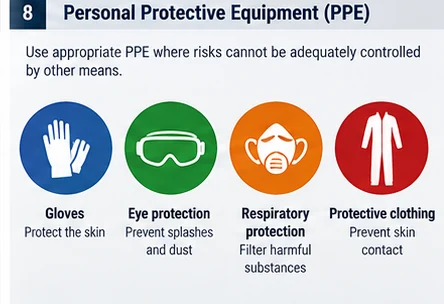
Selecting PPE correctly
Where PPE is needed, selection matters more than simply issuing equipment:
Gloves
Selected for the specific chemical and task, not just "a pair of gloves."
Safety goggles or face protection
Matched to splash, dust or vapour hazards.
Protective clothing
Prevents skin contact with the substance in use.
Respiratory protective equipment (RPE)
The filter or device must actually be rated for the substance and concentration present.
Safe handling and storage
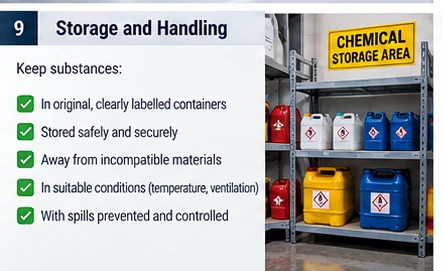
Exposure risk does not stop once a task is finished. Controlling it also means managing the substance while it is received, handled, transferred, stored, transported and used: keep substances in their original, clearly labelled containers, store them securely and in suitable conditions, keep incompatible substances apart, check containers are in good condition, and keep storage areas ventilated and well maintained.
Spill and emergency response
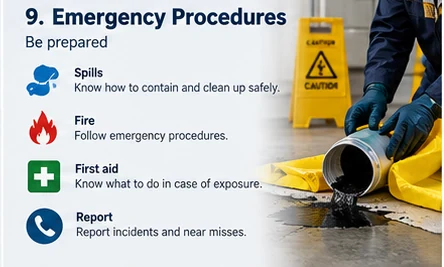
Plan for what could go wrong, not only for routine use: spills, leaks, splashes, uncontrolled releases, damaged containers, accidental mixing of incompatible substances, and exposure incidents. Know your site's spill procedure, use the appropriate PPE, contain and clean up using approved methods, dispose of waste correctly, and report the incident, including seeking medical attention if needed.
Monitoring, review and global frameworks
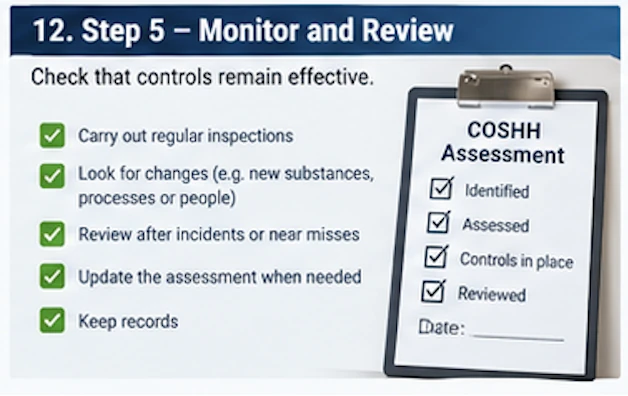
A COSHH assessment is not a one-time form. It stays valid only if the organisation checks that controls keep working and updates the assessment when things change.
Monitoring and health surveillance
Organisations verify that controls remain effective through workplace inspections, exposure monitoring (such as air sampling), testing of control equipment like local exhaust ventilation, health surveillance where required, and review of incidents and worker feedback.
What a good assessment record includes
The hazards identified.
The routes of exposure.
Who is exposed.
Existing controls, and any additional controls needed.
Emergency measures.
Who is responsible for each action.
When the assessment will be reviewed.
A practical example
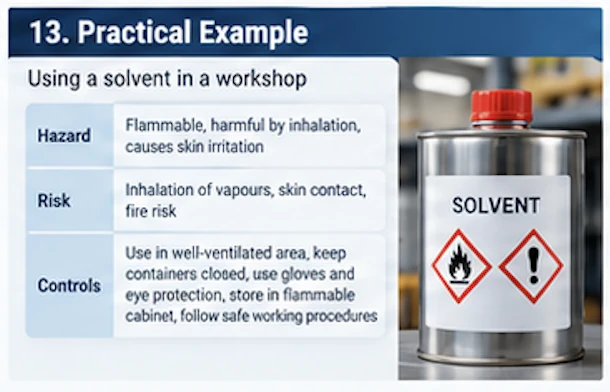
A solvent used in a workshop is flammable, harmful by inhalation, and causes skin irritation. Used briefly with the container closed, the exposure may be minimal. The same solvent poured, sprayed or used for longer periods in a poorly ventilated space creates a materially different risk. The controls follow the task: work in a well-ventilated area, keep containers closed when not in use, wear gloves and eye protection, store the solvent in a flammable-liquids cabinet, and follow the site's safe working procedure.
UK (COSHH Regulations 2002)
The Control of Substances Hazardous to Health Regulations 2002 require UK employers to prevent or adequately control exposure to substances hazardous to health, enforced by the Health and Safety Executive (HSE).
OSHA (United States)
The closest US equivalent is OSHA's Hazard Communication Standard (29 CFR 1910.1200), which requires classification of chemical hazards, safety data sheets, and labels aligned with the same GHS pictograms used under COSHH.
EU (CLP and REACH)
In the European Union, the CLP Regulation (EC No 1272/2008) governs the classification, labelling and packaging of hazardous substances, while the REACH Regulation (EC No 1907/2006) governs their registration and safe use.
ILO (International)
The ILO Chemicals Convention, 1990 (No. 170) sets out international minimum requirements for classifying, labelling and controlling chemicals used at work.
COSHH in pictures
1 / 13
Tap a picture to bring it to the front. Tap the front picture to open it full size.
Official references
Final assessment
The assessment has ten questions. A verified learner must complete all lessons and score at least 80%. A certificate confirms completion and the recorded knowledge score. It does not certify practical competence or authorize you to carry out workplace COSHH assessments unsupervised.
Question 1 of 10