PPE Is the Last Line of Defence. Why Do We Keep Starting There?
PPE is visible, familiar and quick to issue. That convenience can hide a weak control decision: the hazard still reaches the worker, and the final barrier depends on the worker using it correctly every time.
The hierarchy is also a timeline
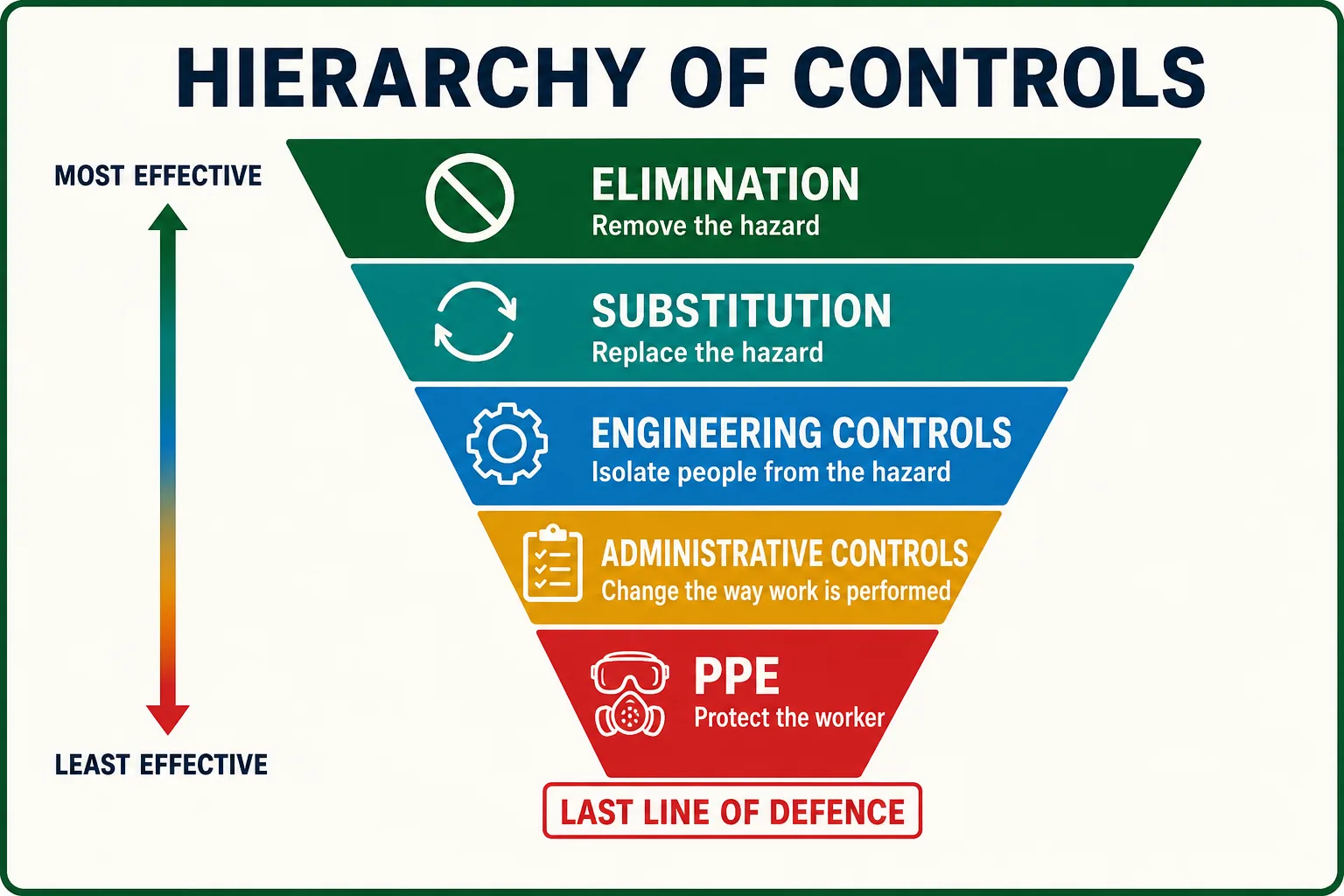
The familiar inverted pyramid ranks controls from elimination to PPE. It also reveals when a company makes its safety decisions.
Elimination often begins when a project team decides whether a hazardous task is needed. Substitution belongs in material and equipment selection. Engineering controls need space, budget and design time. Administrative controls shape the work before it starts. PPE stands at the final point, where the hazard can still reach a person.
When a risk assessment begins with gloves, goggles or respirators, the problem may have started much earlier. A specification was approved, a chemical was purchased or a work method was fixed before anyone asked how to remove the exposure.
Why PPE becomes the first answer
PPE is easy to see and relatively quick to buy. It rarely requires a production line to stop or a process to be redesigned. A box can be ticked, equipment can be issued and the task can continue.
Those practical advantages explain why PPE is common. They do not make it the strongest control. A respirator does not remove contaminated air. A harness does not remove a fall edge. Chemical gloves do not make an avoidable solvent harmless.
The more a control depends on correct selection, fit, inspection, maintenance and individual behaviour, the more ways it can fail during ordinary work. PPE may be essential, but it usually manages the remaining exposure rather than its source.
What each level changes
Elimination removes the hazard. A design that allows equipment to be serviced at ground level can remove routine work at height.
Substitution replaces the hazard with a safer material, machine or method. The replacement still needs assessment because it may introduce a different risk.
Engineering controls isolate people from the hazard. Guards, enclosures, local exhaust ventilation and remote handling change the physical workplace.
Administrative controls change how people organize and perform the work. Procedures, permits, access restrictions, supervision, inspection and training sit here.
PPE protects the individual from the exposure that remains. It belongs in the control plan when the risk assessment shows it is needed, including for residual risk, maintenance and emergency conditions.
The hierarchy is not a demand to install every possible control. Start at the top, choose the highest controls that are feasible and effective, and combine measures when one cannot control the risk adequately.
HSE cannot repair every late decision
HSE should influence the work before the purchase order, the construction package and the operating procedure are approved. Designers, engineers, buyers, managers, supervisors and workers all own part of the control decision.
If an HSE professional joins after the machine, chemical and method have been selected, the remaining choices may be limited to rules and PPE. Earlier involvement can change a specification, remove a hazardous step, select safer equipment or build isolation into the design.
This is what putting HSE before the task means in practice. It does not mean asking the HSE department to sign the last page. It means using safety information while the company can still change the source of risk.
US OSHA: a clear preference, several legal routes
US OSHA describes the hierarchy as elimination, substitution, engineering controls, administrative controls and PPE, arranged from most to least effective. Its Recommended Practices for Safety and Health Programs tell employers to emphasize engineering solutions, including elimination and substitution, before safe work practices, administrative controls and PPE.
The legal claim needs care. The United States does not have one universal rule requiring every company to display a five-level hierarchy document. Binding duties come from the Occupational Safety and Health Act, applicable federal or state standards, and the facts of the hazard. Several OSHA standards require particular engineering or work-practice controls before employers rely on respirators or other PPE.
For general industry PPE, 29 CFR 1910.132 requires the employer to assess the workplace for hazards that require PPE, select suitable protection, communicate the decision, ensure proper fit and certify that the assessment was completed. PPE is therefore part of a hazard-control decision, not a substitute for assessing the workplace.
EU law: prevention before individual protection
The EU Framework Directive 89/391/EEC is more explicit about prevention principles. Article 6 requires employers to avoid risks, evaluate unavoidable risks, combat risks at source, adapt to technical progress, replace dangerous options and give collective protective measures priority over individual protection.
The Directive applies broadly across public and private sectors, with limited exceptions for certain specific public-service activities. Member States implement it through national law, which may add detail or stricter requirements. Companies must check the rules in the country where the work takes place.
The PPE Directive 89/656/EEC states that PPE shall be used when risks cannot be avoided or sufficiently limited by collective technical protection or by work-organization measures, methods or procedures. EU-OSHA guidance follows the same principle: control the risk at source and give collective protection priority before individual equipment.
Follow one solvent through the hierarchy
Suppose workers clean parts in an open container of hazardous solvent. Starting with gloves treats contact as inevitable. Starting at the top produces a different review.
Elimination asks whether the cleaning step is needed. Substitution considers a less hazardous product or process. Engineering controls may include an enclosed cleaning unit and local exhaust ventilation. Administrative controls cover restricted access, written methods, training, inspection and maintenance.
Suitable gloves, eye protection and respiratory protection may still be required for the remaining exposure. The PPE supports the stronger controls. It does not justify leaving an avoidable open solvent bath beside the worker.
A pyramid poster is not evidence of control
A useful risk assessment identifies the hazard, who may be exposed and the credible consequences. It records the higher controls considered, the measures selected, the reason for the decision and the person responsible for delivery. If a stronger control is not available, record the technical or operational reason and any interim protection.
The assessment should also state how the controls will be checked. Engineering controls need inspection and maintenance. Administrative controls need supervision and review. PPE needs correct selection, compatibility, fit, cleaning, storage, replacement and training.
Every company needs a defensible control process. That does not mean every company has the same legal duty to display the same pyramid. EU employers work under broad prevention principles implemented through national law. US employers must follow the standards and duties that apply to their hazards and industry.
Put the hierarchy into real decisions
At concept and design, ask whether the hazard can be removed. During procurement, compare safer materials, equipment and methods. Before installation or commissioning, confirm the required engineering controls. During work planning, define the remaining administrative controls and PPE. At the workplace, verify that each control is present and effective.
Look closely when every corrective action ends with retraining or new PPE. Other warning signs include respirators introduced without reviewing ventilation, harnesses chosen without considering edge protection, and gloves selected without asking whether the chemical can be replaced.
Changing design, equipment or production may be harder than issuing PPE. That difficulty is a reason to plan earlier, not a reason to skip the higher levels.
Send a PPE-first plan back with six questions
Can we remove the hazard or the task? Is there a safer material or method? Can design isolate people from the source? Which rules and supervision remain necessary after those changes? What residual risk still requires PPE? What evidence shows that every selected control works in the workplace?
Sources & Further Reading
- US OSHA: Identifying Hazard Control Options, The Hierarchy of Controls
- US OSHA: Recommended Practices for Safety and Health Programs
- US OSHA: 29 CFR 1910.132, General PPE requirements
- EUR-Lex: Council Directive 89/391/EEC, Articles 5, 6 and 9
- EUR-Lex: Council Directive 89/656/EEC on PPE at work
- EU-OSHA OSHwiki: General principles of EU OSH legislation
Author/editor: HSE Hub Editorial
Last reviewed: September 5, 2026
Image note: The original AI-generated hierarchy illustration was created for HSE Hub.
Legal note: US requirements vary by hazard, industry, applicable OSHA standard and state plan. EU directives are implemented through national law. Check the rules that apply to your workplace.
Disclaimer: This article provides general HSE education. It does not replace applicable law, regulatory guidance, engineering judgment or advice from a competent professional.