How HSE Connects to the UN Sustainable Development Goals
Safe work, practical training, pollution control and resilient reconstruction support several UN goals. The connection becomes useful when it changes decisions at the worksite.
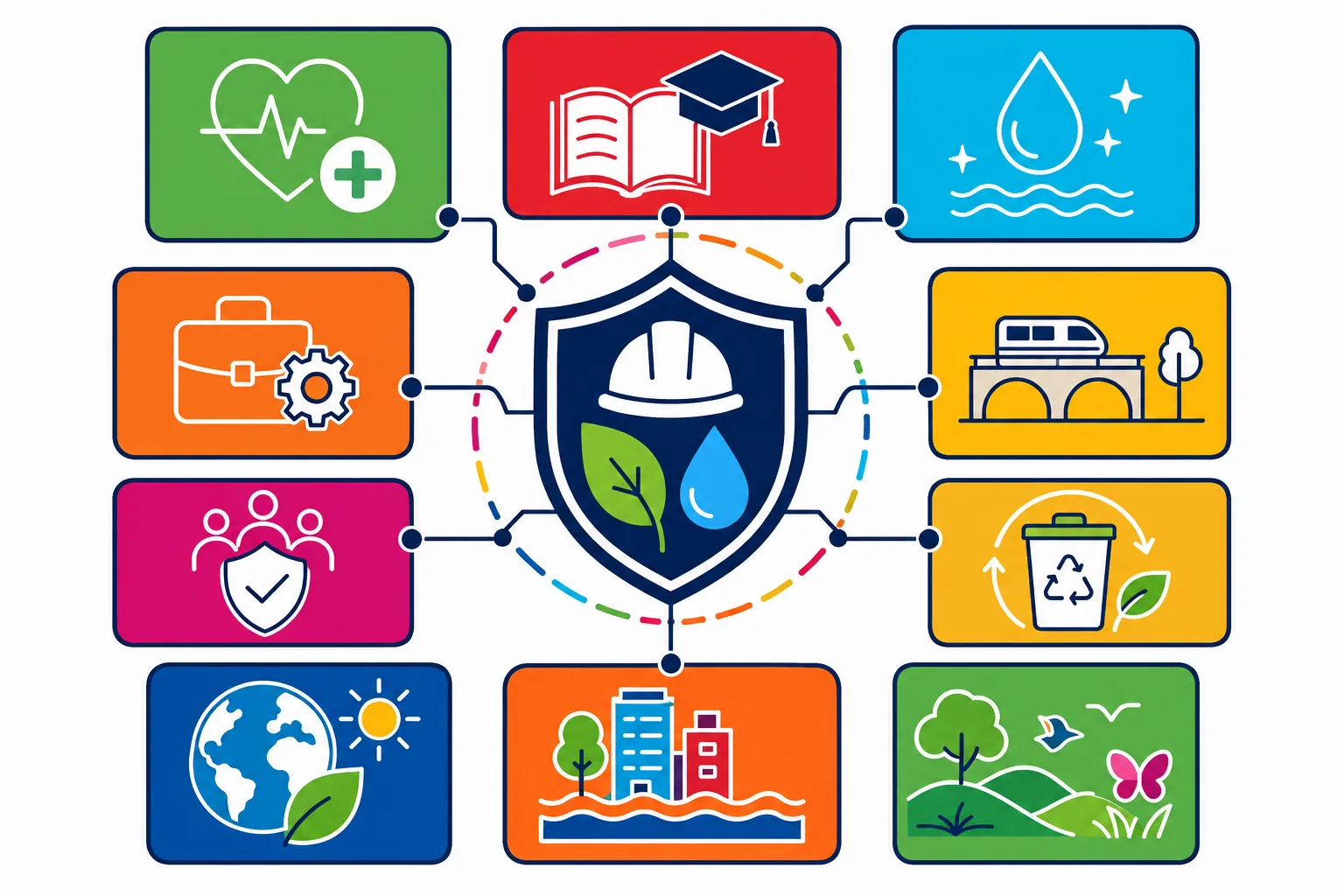
The connection is practical, not decorative
The United Nations adopted the 2030 Agenda for Sustainable Development in 2015. It contains 17 goals and 169 targets covering health, education, decent work, infrastructure, communities, production, climate and the natural environment.
HSE does not cover every part of that agenda, and displaying an SDG wheel does not prove sustainable performance. The useful question is narrower: which goals depend on decisions that HSE professionals, employers, workers and project leaders make every day?
SDG 8: Safe work is part of decent work
Goal 8 calls for decent work and economic growth. Target 8.8 specifically addresses labour rights and safe, secure working environments for all workers, including migrant workers and people in precarious employment. Its indicators include fatal and non-fatal occupational injuries.
This places familiar HSE duties inside a wider development goal. Safe access, suitable equipment, competent supervision, worker consultation and reliable critical controls affect whether employment is genuinely decent. A new project cannot claim social progress while exposing its workforce to preventable harm.
SDG 3: Health includes prevention at work
Goal 3 concerns health and well-being. Target 3.9 calls for fewer deaths and illnesses caused by hazardous chemicals and air, water and soil pollution. Occupational health therefore belongs in the same conversation as public health.
Exposure assessment, substitution, ventilation, respiratory protection, hygiene facilities and health surveillance can reduce harm when they are selected and managed correctly. PPE remains important, but it should not become the default answer when elimination, substitution or engineering controls are reasonably practicable.
SDG 4: Practical HSE education builds capability
Goal 4 covers quality education. Target 4.4 refers to technical and vocational skills, while target 4.7 includes education for sustainable development. HSE training supports both when it teaches people how to recognize hazards, assess risk, apply controls and respond to emergencies.
Language access matters. Training offered in English, Arabic and Kurdish Kurmanji can reach more workers in Syria and the wider region. Translation alone is not enough. Technical content still needs competent review, clear examples and assessments that test understanding rather than memory.
SDG 6: Water and sanitation are workplace issues
Goal 6 addresses clean water and sanitation. Target 6.3 focuses on water quality, wastewater, dumping and the release of hazardous chemicals. These are direct operational concerns for construction, manufacturing, camps, workshops and healthcare facilities.
Sites need safe drinking water, adequate toilets and washing facilities, controlled drainage, spill response and proper wastewater management. Poor arrangements can affect workers first, then nearby households, agriculture and groundwater.
SDG 9: Reconstruction needs safe, resilient infrastructure
Goal 9 calls for resilient infrastructure and sustainable industrial development. In areas rebuilding after war, the pressure to restore homes, roads, utilities and workplaces is understandable. Speed, however, does not remove risk.
Unstable structures, damaged utilities, unexploded ordnance, poor lifting arrangements, traffic interfaces, dust and weak contractor controls can turn reconstruction into another source of injury. Risk assessment, competent design, permit systems, temporary works control and quality assurance help create infrastructure that is safe to build and dependable to use.
SDG 11: Project decisions affect whole communities
Goal 11 aims for safe, resilient and sustainable cities and communities. Construction and industrial projects influence traffic, noise, air quality, waste, emergency access and the stability of nearby structures. These effects do not stop at the site boundary.
A sound HSE plan identifies who may be affected, including children, older people and residents with limited mobility. It also sets controls for public access, vehicle routes, dust, waste, emergency communication and work near occupied buildings.
SDG 12: Chemicals, materials and waste need control
Goal 12 concerns responsible consumption and production. Target 12.4 addresses the environmentally sound management of chemicals and waste, and target 12.5 calls for waste prevention, reduction, recycling and reuse.
These aims appear in practical HSE work through chemical inventories, safety data sheets, compatible storage, spill prevention, waste segregation and controlled disposal. Procurement decisions also matter. Choosing a less hazardous material or ordering only what is needed can prevent risk before it reaches the site.
SDG 13: Climate risks change working conditions
Goal 13 addresses climate action, including resilience and education. For HSE teams, climate change is already an operational issue. Heat, wildfire smoke, severe weather, flooding and water scarcity can affect exposure, fatigue, emergency plans and the reliability of equipment.
A heat plan should use local conditions, workload, clothing, acclimatization, rest, hydration and medical response. Emergency arrangements should also consider whether roads, power, communications and evacuation routes will remain available during extreme weather.
SDG 15: Protect land before damage occurs
Goal 15 concerns terrestrial ecosystems, land degradation and biodiversity. Construction and industrial activity can damage soil, vegetation, habitats and agricultural land through spills, excavation, erosion, waste and uncontrolled access.
Baseline surveys, protected areas, erosion control, bunding, careful material storage and restoration plans reduce that risk. Monitoring should continue long enough to confirm that controls worked, rather than ending when the contractor leaves.
Turn the goals into site decisions
The SDGs are most useful when they help people ask better questions. Which activities could seriously harm workers or neighbours? Which controls prevent that harm? Who checks that those controls are present and effective? What waste, emissions or land disturbance will the project create? Can a safer material or method remove the risk earlier?
Projects can then select a small set of measures that reflect real performance, such as occupational injury rates, verified critical controls, exposure results, training completion by language, water quality, waste recovery and closure of environmental actions.
The SDGs do not replace national law, permits, ISO management systems, engineering standards or competent professional judgment. They provide a shared framework for connecting site decisions with worker health, community safety and environmental protection.
A useful commitment is specific
Choose the SDG targets that genuinely relate to your work, connect each one to a risk or impact you control, assign responsibility and publish evidence. Avoid claiming contribution where you cannot show the decision, control or result behind it.
Sources & Further Reading
- United Nations: The 17 Sustainable Development Goals
- United Nations: Goal 3, Good Health and Well-being
- United Nations: Goal 4, Quality Education
- United Nations: Goal 6, Clean Water and Sanitation
- United Nations: Goal 8, Decent Work and Economic Growth
- United Nations: Goal 9, Industry, Innovation and Infrastructure
- United Nations: Goal 11, Sustainable Cities and Communities
- United Nations: Goal 12, Responsible Consumption and Production
- United Nations: Goal 13, Climate Action
- United Nations: Goal 15, Life on Land
- International Labour Organization: Safety and health at work
Author/editor: HSE Hub Editorial
Last reviewed: September 5, 2026
Image note: This original AI-generated illustration was created for HSE Hub. It does not reproduce the official United Nations SDG wheel, emblem or goal icons.
Independence statement: HSE Hub is not affiliated with or endorsed by the United Nations.
Disclaimer: This article provides general HSE education. Apply applicable law, standards, engineering judgment and competent professional advice to your specific operation.